Inspection of the Forge Ring
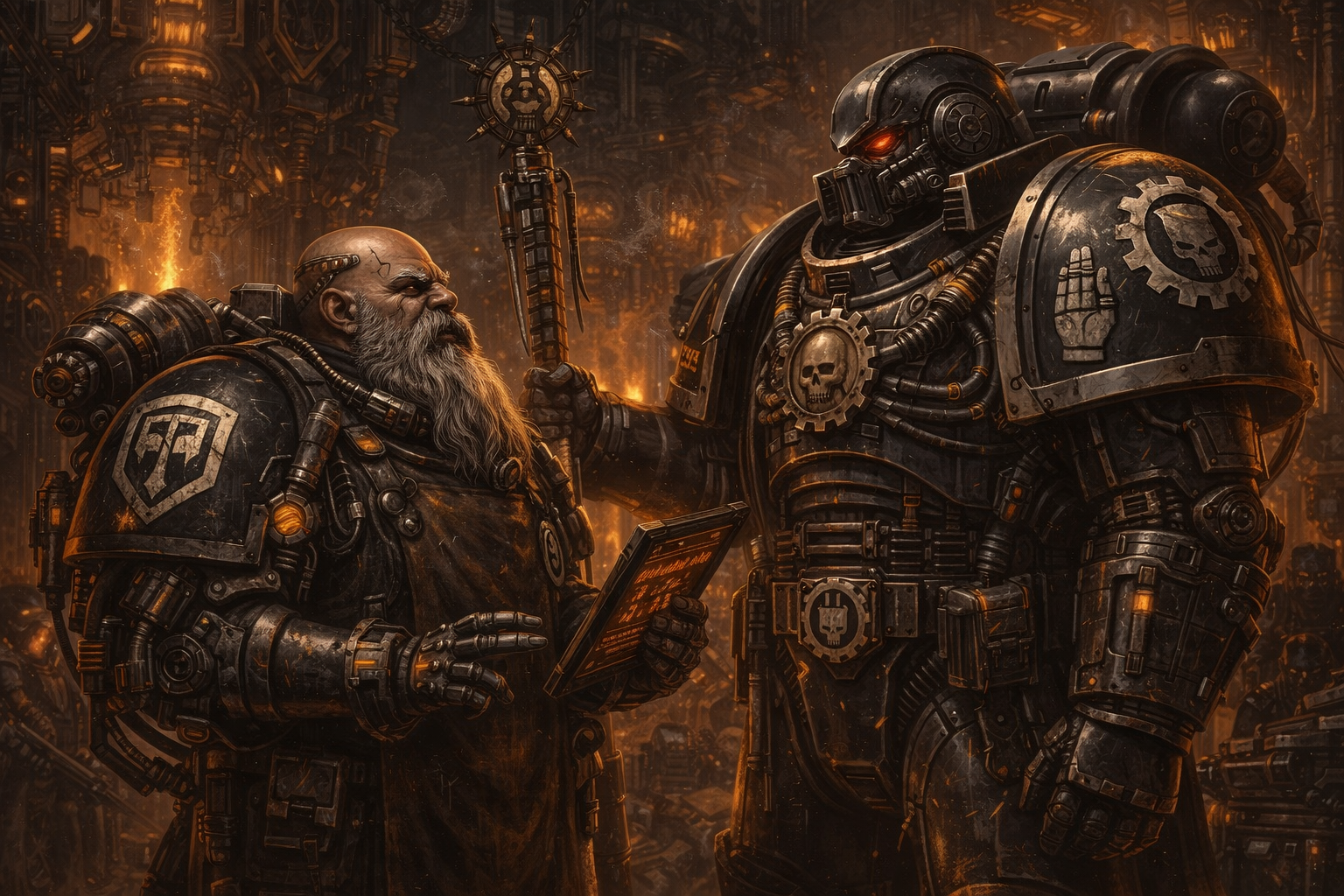
Inspection of the Forge Ring
Vôrun-Hold – Vidal Sector
The Forge did not roar.
It operated.
Plasma containment fields shimmered within vaults carved from asteroid stone. Alloy billets rotated in gravitic suspension, impurities burning away in controlled arcs. Heat bled outward through conduits embedded deep into rock mass.
The Iron Hands arrived without ceremony.
Five figures in black ceramite, silver left arms reflecting furnace glow. Servo-arms folded close. Auspex arrays active, restrained.
At their center walked Iron Father Blantar.
Durn Khel met them at the threshold of the Forge Ring.
No escort.
No heraldry.
Heavy gloves. Diagnostic slate in one hand.
“You will not access restricted biological or core systems,” Durn said.
“It was not requested,” Blantar replied.
Durn turned.
“Then we proceed.”
Outer Smelt Clusters
The Iron Hands scanned in silence.
Spectrometer lattices rippled across containment fields. Thermal variance patterns displayed briefly across Blantar’s visor.
“Impurity ratio?”
“Zero-point-zero-one-eight percent after primary refinement,” Durn replied. “Reduced to zero-point-zero-zero-four prior to casting.”
Blantar processed.
“Acceptable.”
They advanced.
One of the Iron Hands paused near a heat-bleed conduit cut into asteroid stone.
“Thermal dispersion is asymmetrical.”
“It is,” Durn said. “Rock density variance along that vector. We compensate through load shifting.”
Blantar extended a probe arm, recalibrating the scan angle.
“You could mirror the conduit. Cumulative stress reduction over extended cycles.”
Durn stopped.
Silence.
He studied the heat map. Calculated the strain curve mentally.
“Two-point-three percent efficiency gain over one hundred cycles,” he said.
Blantar did not nod.
“Two-point-three percent accumulates.”
A faint twitch at the corner of Durn’s mouth.
“Yes.”
He marked the conduit on his slate.
They moved on.
Fabrication Galleries
Gravitic anchor assemblies hung suspended between multi-level gantries. Servo-cranes moved with deliberate precision. Plasma manifold housings rotated within calibration rings while Brôkhyr teams adjusted micro-tolerances manually.
Blantar stopped before a completed anchor module.
“Certification threshold?”
“Twelve percent above rated output.”
“Demonstrated.”
The module locked into a stress frame. Load increased gradually.
Twelve percent.
Stable.
Blantar’s optics remained fixed on the curve.
“Push to fourteen.”
The nearby Brôkhyr stiffened.
Durn did not.
“Proceed.”
Load surged.
Oscillation began to build at thirteen-point-seven percent.
Durn lifted one gloved hand.
“Reduce.”
Load dropped.
The oscillation broke.
Baseline restored.
Blantar regarded him.
“You do not certify maximum survival.”
“I certify repeatable survival.”
A pause.
“Held once,” Durn added evenly, “is not held.”
Blantar’s voice was level.
“Prudent.”
Throughput
They stopped along a mid-tier corridor where heat from smelt clusters vibrated faintly through alloy plating.
Blantar spoke without preamble.
“What constrains your output?”
Durn answered just as plainly.
“Isotope purity variance in plasma feedstock. Salvage contamination unpredictability. Heat bleed inefficiency beyond long cycles.”
“Fleet capacity?”
“Localized. Defensive orientation.”
“Expansion intent?”
“No.”
A fractional pause.
“The flesh is weak,” Blantar said.
Durn’s eyes flicked briefly to the Iron Father’s silver arm.
“Metal fractures if stressed without measure.”
Silence.
Then — short, low, unexpected —
Durn laughed.
Blantar regarded him.
“Clarify,” the Iron Father said.
“You test for ambition,” Durn replied. “We optimize. We do not expand.”
Blantar studied him for several seconds longer than necessary.
Assessment.
Not suspicion.
Final Classification
They returned to the threshold of the Forge Ring.
No mention of deeper systems.
No probing beyond scope.
Blantar folded his servo-arms back into resting configuration.
“Production capacity is disciplined. Containment architecture is rational. Stress protocols are controlled.”
A beat.
“Deviation risk is within acceptable parameters.”
Durn inclined his head once.
Blantar’s optics dimmed slightly — the closest thing to approval an Iron Father grants.
“Operational utility confirmed.”
A pause.
Then, final:
“We will formalize exchange.”
Not an offer.
Not negotiation.
A statement of outcome.
Durn nodded.
“Through proper channels.”
Blantar turned without ceremony.
The Iron Hands departed the Forge Ring in measured silence.
Behind them, plasma fields hummed.
Stress curves adjusted.
Heat bled into stone.
Durn remained standing for several seconds after they left.
Two-point-three percent accumulates.
Yes.
It does.
Good.
After the Departure
Spine Chamber – Vôrun-Hold
The dock lights dimmed as the Iron Hands strike vessel disengaged from Vôrun’s outer moorings.
In the high chamber of the Spine, the asteroid’s slow rotation hummed through structural ribs.
Thôrmun stood at the central display column, watching the departing vessel shrink against the void.
Behind him, the light shifted.
Eidram Vôr-Index manifested in a lattice of amber projections — not fully embodied, not distant either. Present enough.
“They have departed,” Eidram said.
“Yes,” Thôrmun replied.
A pause.
“Inspection variance exceeded standard containment tolerance by twelve percent,” Eidram continued. “Exposure of production architecture increases predictive modeling risk.”
“Yes.”
“You permitted this.”
“Yes.”
Silence settled like dust.
Deviation
Eidram’s light shifted subtly — a sign of internal recalculation.
“Deviation increases failure probability. Unknown observers reduce strategic opacity. Strategic opacity preserves autonomy.”
Thôrmun did not turn.
“And opacity invites investigation.”
“Correct.”
“And investigation invites force.”
Eidram did not answer immediately.
The silence was calculation, not hesitation.
“Probability of escalated scrutiny decreases when system classification is ‘contained utility,’” Eidram said at last.
“Yes.”
“You chose containment over concealment.”
“I chose survival.”
The Balance
Eidram’s projection sharpened slightly.
“Survival was not under immediate threat.”
“Not today.”
Thôrmun finally turned.
“If we become an unknown variable in their equations, they will solve us.”
Eidram processed this.
“Your decision reduces risk of forced data acquisition.”
“Yes.”
“Your decision increases data exposure.”
“Yes.”
The chamber fell quiet again.
Thôrmun’s voice lowered slightly.
“Survival outranks triumph.”
Eidram’s response was immediate.
“Deviation increases failure.”
They regarded one another — not adversaries, not allies. Components.
Assessment
“The Iron Hands classification was favorable,” Eidram said.
“Operational utility confirmed.”
“Yes.”
“Expansion intent was denied.”
“Correct.”
Eidram’s light flickered faintly — satisfaction, though it did not name it.
“Margin preserved,” it concluded.
“Margin adjusted,” Thôrmun corrected.
A fractional pause.
“Two-point-three percent,” Eidram said.
Thôrmun allowed the smallest hint of a smile.
“Yes.”
Final Vector
“The Forge remains distributed. The Crucible remains sealed. The Core remains unexposed,” Eidram summarized.
“Yes.”
“Necron lattice containment remains within acceptable bounds.”
“Yes.”
“Probability of Iron Hands escalation: reduced.”
“Yes.”
The asteroid hummed around them — industry below, void above.
Eidram dimmed slightly.
“Your strategy prioritizes continuity.”
“It always does.”
“And if the Iron Hands shift posture?”
Thôrmun’s gaze returned to the stars.
“Then we adapt.”
Eidram’s final words lingered in the chamber:
“Adaptive systems survive.”
Thôrmun nodded once.
“Yes.”
The projection dissolved into the Spine’s quiet glow.
Below, the Forge continued its measured hum.
Deviation contained.
Survival extended.
Margin intact.