Keln Veyd — Master of Vôrun’s Reach
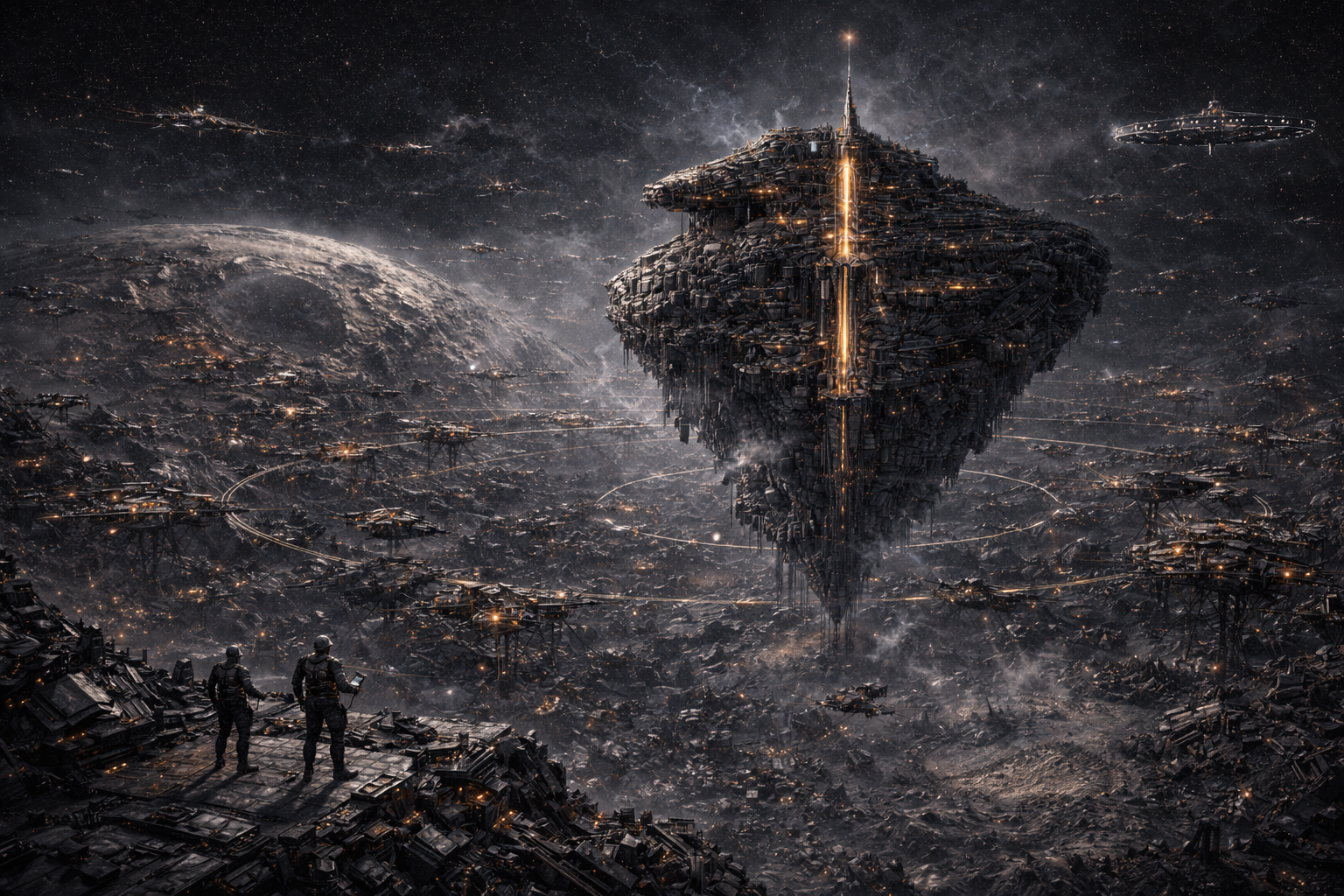
Keln Veyd — Master of Vôrun’s Reach
Commander of the Hernkyn Yaegirs of Vôrun-Hold
In the peripheral dark beyond the carved stone of Vôrun-Hold, beyond the Forge Ring and the echoing galleries of deliberation, there is another architecture entirely.
Not walls.
Not banners.
Not ceremony.
There is tension.
And the Kin who holds that tension is Keln Veyd.
The Reach of Vôrun
Where others see salvage fields and drifting debris halos around Hypnoth’s dead orbit, Keln sees structure.
The Hernkyn Warrens are not glamorous.
They are docking spines grown from wreckage.
Scrap-built listening posts.
Micro relays disguised as degraded hull fragments.
Trade outposts that look like temporary junk clusters.
Underneath that disorder:
Sensor arrays.
Gravitic triangulation nodes.
Kill lanes mapped in advance.
Fallback vectors layered in silence.
This network is known simply as Vôrun’s Reach.
Twenty Yaegirs.
Two Kapricus carriers.
Five autonomous cells.
No banners.
No parades.
They are first contact.
They are first warning.
They are the silence before the Hearthguard fall from the void.
Origins in the Diaspora
Keln was not born in stone.
He was raised among transient hulls during the post-Örgvayr contraction, when Kindreds drifted between unstable routes and survival meant movement, not fortification.
He learned early:
Heavy forces decide wars.
Light forces prevent disasters.
His first combat was not glorious. It was withdrawal.
Elastic repositioning saved him when stubborn defense would not.
He chose the Hernkyn path deliberately.
Not because he lacked strength.
Because he understood timing.
The Commorragh Incident
Before the raid sanctioned by Uthar the Destined, before the political fracture that would follow, there was a smaller failure.
A salvage intercept near Drukhari corridors.
An ambush.
Three Kin captured.
Keln among them.
The Drukhari did not seek his death.
They offered him a choice.
One released.
Two flayed.
He chose.
And he chose emotionally.
Not tactically.
He chose the Kin he liked least in that moment.
The Drukhari let him live with that.
He returned to Vôrun altered—not broken, but compressed.
From that day forward, he rejected symbolic escalation.
He warned High Kâhl Thôrmun Vôrrek against punitive raids into Commorragh.
When Uthar proposed a coordinated strike to retrieve prisoners and restore morale across multiple Leagues, Keln advised against it.
Thôrmun supported the raid reluctantly, demanding compensation safeguards.
The raid failed to produce lasting deterrence.
And Uthar’s Margin arrived soon after.
Vôrun’s Reach Under Suspicion
Keln’s perimeter network once malfunctioned.
A calibration fault in a relay cluster accelerated salvage degradation signatures beyond natural tolerance. Observing Iron Hands detected anomaly patterns.
What had been statistical rumor became confirmed presence.
Inspection followed.
Trade treaty followed.
Concealment ended.
Margin interpreted it as incompetence.
Keln interpreted it as proof that no web is perfect.
He expanded redundancy.
He reduced ornamentation.
He tightened discipline.
Doctrine of Refusal
For years, Keln enforced a rule:
No rescue into torture domains.
If captured, the Reach does not escalate blindly.
Probability outweighs attachment.
The twenty accepted this.
They operate knowing no cavalry follows them into the abyss.
Survival through discipline.
The Rescue That Broke Doctrine
Then one of his cell leaders was taken.
Rôvik Thrynn.
Rôvik knew the rule.
Rôvik expected abandonment.
Keln ran the numbers.
And broke his own doctrine.
Full insertion.
Hearthguard drop without complete shaping.
Overcommitment of force.
The rescue succeeded.
Rôvik survived.
Later, in private, Rôvik confronted him:
“You chose them because you disliked them.”
Keln did not deny it.
Rôvik responded:
“That is not weakness. Pretending it was logic is.”
Rôvik became his external moral calibration.
Not soft.
Not accusatory.
Clear.
When Rôvik later fell in a clean engagement, Keln did not regress.
He stood firm.
Because clarity had already been integrated.
Temperament
Keln is not loud.
He does not rage.
He does not sermonize.
He speaks in short directives.
He despises theatrical war.
He hates prolonged suffering more than death.
He is tired of this grim dark future—not of duty, but of spectacle.
He believes he protects the Kin by reducing unnecessary suffering.
He will choose conviction over obedience.
He will delay transports if escalation is vanity.
He will accept political fallout if it prevents skinned Kin.
He drinks, sometimes.
Never before command.
Never before deployment.
Alone.
Relationship With Others
Thôrmun Vôrrek
Respects his caution. Values his probability logic.
Durn Khel
Sees him as an efficiency multiplier. Supplies him pragmatically.
Moktar Vôrunsdóttir
Understands his fracture. Watches him not as threat—but as weight-bearer.
Kâhl Drakmir
Philosophical opposite. Believes strength is revealed in cost. They disagree—but respect is earned.
Uthar’s Margin
Distrust him. See autonomy as deviation. Await instability that does not arrive.
The Blind Spot
The Reach feels vibration.
Drukhari cruelty leaves ripples.
But something older watches without disturbance.
Necron observation has begun.
Keln prepares against visible predators.
The silent ones catalogue patiently.
Final Assessment
Keln Veyd is not a hero.
He is not a martyr.
He is not a zealot.
He is a perimeter commander shaped by one ugly choice and refined by one honest confrontation.
He has learned that in this age:
There is no clean arithmetic.
Only cost.
And he will bear it.
In the dark beyond Vôrun-Hold’s carved stone,
where scrap becomes sensor and silence becomes structure,
Keln Veyd stands at the edge.
Not as a spider at the center.
But as the tension along the thread.
And when the thread tightens—
The Hammer falls.