The Agricultural Vaults of Vôrun-Hold
The Agricultural Vaults of Vôrun-Hold
Closed Loops Beneath Stone
The Agricultural Vaults were carved later than the Forge Rings.
Not because food was an afterthought.
But because stone remembers.
Every chamber cut into the asteroid alters the way mass distributes through its interior. Industrial caverns could tolerate irregular geometry. Agricultural systems could not. They required controlled volumes, stable humidity fields, regulated airflow corridors, and light arrays that did not fluctuate with the Hold’s power cycles.
So the first vaults were cut slowly.
Measured.
Reinforced before they were planted.
They lie today along the mid-structural rings of Vôrun-Hold, where the gravitational stabilizers produce the most consistent load distribution. Workers who enter them from the industrial corridors notice the change immediately.
The Forge smells of coolant and heated metal.
The vaults smell alive.
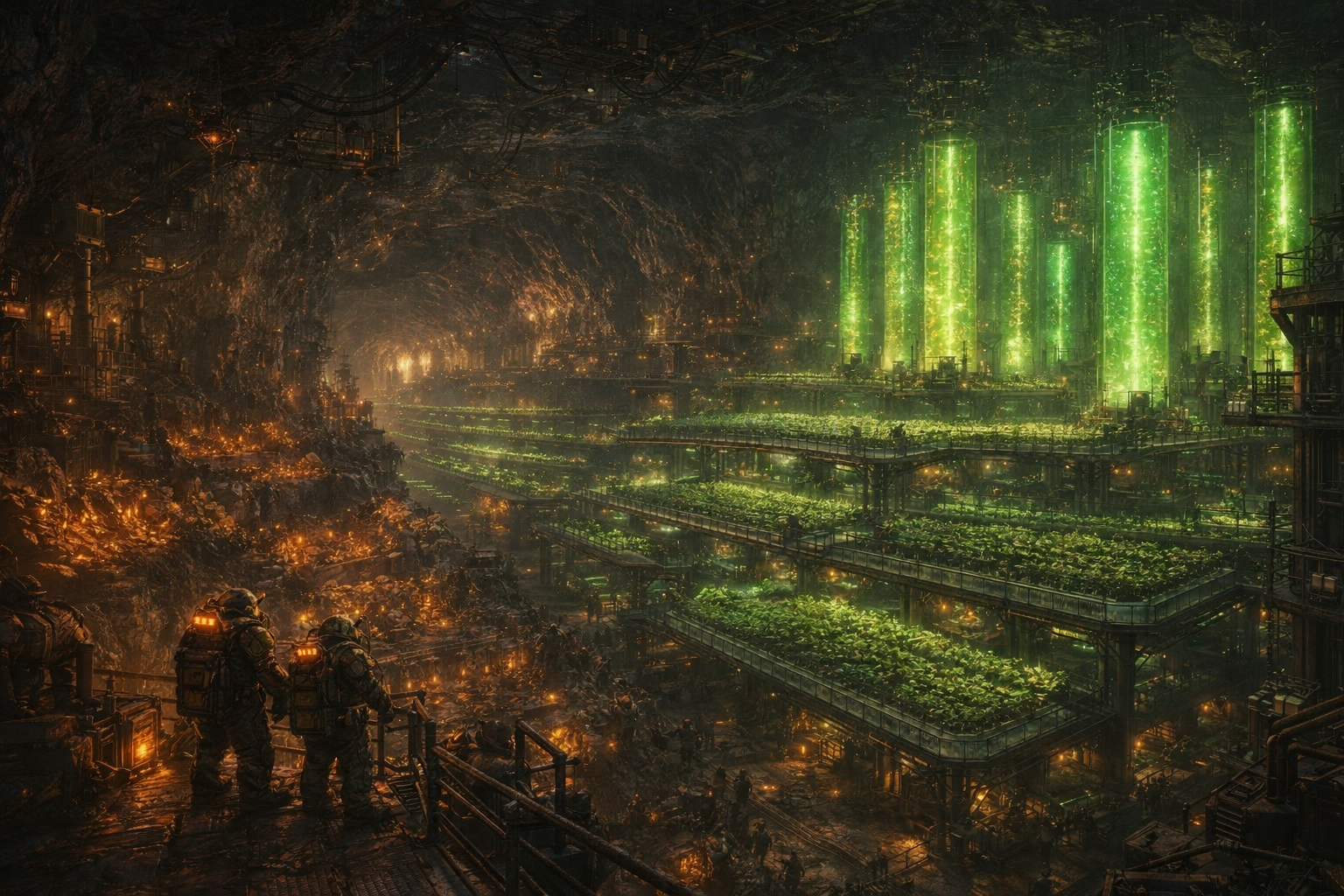
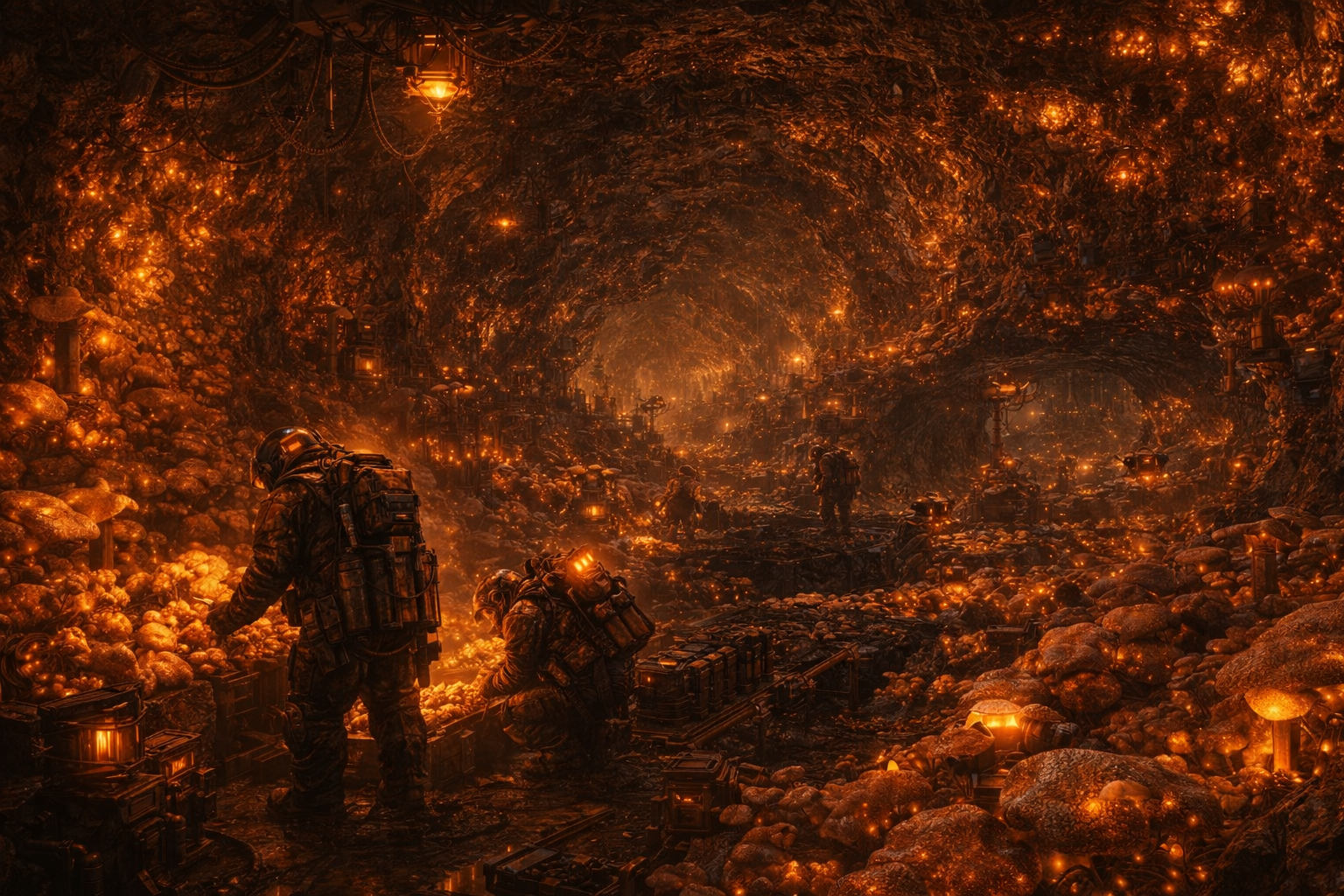
Warm air moves through layered racks of hydroponic root beds. Fungal culture walls glow faintly under bioluminescent growth strips. Algae reactors line the upper chambers, circulating nutrient slurry through transparent columns that also serve as auxiliary oxygen buffers for the Hold’s atmosphere.
None of it is ornamental.
Everything in the vaults exists to close a loop.
Waste biomass from habitation districts is broken down by microbial digesters. The resulting nutrient solution feeds fungal substrates and hydroponic crops. Water extracted from salvage ice or atmospheric condensers circulates continuously through filtration lattices before returning to the growth chambers.
A Kin could live their entire life within the Hold without seeing sunlight.
But they would eat the result of a thousand controlled cycles of light.
The Fungal Staple
Most Kin meals begin in the fungal beds.
The primary protein culture—an engineered mycoprotein strain adapted during the early decades of the Hold—grows rapidly on processed biomass. It requires little light and tolerates the slight atmospheric fluctuations that sometimes ripple through the asteroid when large industrial systems change load.
Cthonian workers often joke that the fungus grows faster than they can carve stone.
The statement is only partially exaggerated.
Under stable conditions the culture doubles its productive mass every forty-eight hours. Once harvested, the biomass is processed into dense nutrient blocks that form the basis of most Hold rations.
It is efficient.
It is reliable.
And after several generations, it became the taste of home.
Light in the Stone
Carbohydrate production requires something fungus cannot provide: energy.
So the vaults contain stacked hydroponic towers where root crops grow under spectral light arrays tuned specifically for high-efficiency starch production. Potatoes and modified tuber strains dominate these chambers because they convert light into calories with minimal wasted biomass.
The lighting systems draw power directly from the Hold’s reactor grid, which means every expansion of agricultural capacity increases the asteroid’s energy load.
Engineers monitor these systems carefully.
Plants are patient.
Power grids are not.
The Algae Columns
Above the root towers rise the algae reactors.
These tall cylinders circulate dense cultures of spirulina-like organisms that produce both protein and oxygen as they grow. Their constant bubbling motion has earned them a nickname among Kin technicians.
The breathing walls.
They are the quietest machines in the Hold.
But without them the air would turn stale within weeks.
Capacity
For decades the agricultural vaults maintained equilibrium.
Population growth from the Crucible remained modest. Industrial expansion created new work crews but did not dramatically increase the number of mouths the vaults needed to feed.
When minor deficits appeared, nutrient imports from external trade compensated easily.
The ledger marked these adjustments as acceptable variance.
But equilibrium depends on balance.
And balance depends on limits.
Every agricultural expansion required more carved volume. Every carved chamber required additional reinforcement ribs. Every reinforcement rib redistributed the asteroid’s internal load.
The stone tolerated these changes.
Until the day engineers began asking whether it would tolerate the next one.
The Quiet Ceiling
The first indication of a limit did not come from the vaults themselves.
It came from Dock Ring Three.
Nutrient shipments arriving from Iron Hands supply networks increased gradually over several cycles. Each shipment was small—compressed algae sheets, preserved biomass, stabilized protein cultures—but their frequency grew.
Imports filled a gap that the vaults could no longer close alone.
Not because the vaults were inefficient.
Because they were full.
Every available chamber capable of sustaining agricultural conditions had already been carved.
Additional expansion would require cutting deeper into the asteroid’s structural zones.
That meant more ribs.
More load.
More stone removed from the mass holding the Hold together.
The Island
Cthonian engineers eventually began describing the Hold with a word not often used in void architecture.
Island.
Not because it floated in water.
But because it had boundaries that could not easily move.
Everything within the asteroid depended on what the stone could support.
Everything outside the asteroid depended on what Dock Ring Three could process.
Between those two limits lay the entire civilization of Vôrun-Hold.
The Calculation
When the agricultural vaults reached their maximum sustainable footprint, the ledger marked the moment quietly.
No warning glyphs appeared.
No emergency protocols activated.
The system simply recorded a new parameter:
Internal food capacity: stabilized.
From that point forward, every additional Kin required compensation from somewhere else.
More imports.
More cargo.
More traffic through the docking rings.
The vaults continued to produce.
The fungus continued to grow.
The algae columns continued to breathe.
But the Hold had reached the point where survival depended not only on what it could grow beneath stone…
…but on how much space it had left to grow at all.