Hypnoth -The World of Recoverable Structure

Hypnoth -The World of Recoverable Structure
Suggested supporting images in order:
Hypnoth from orbit
Descent over the ruin belts
The Glass Meridian
Salvage on Hypnoth
The Anchor Mountains
The Ash Dorsae
The Crucible Sinks
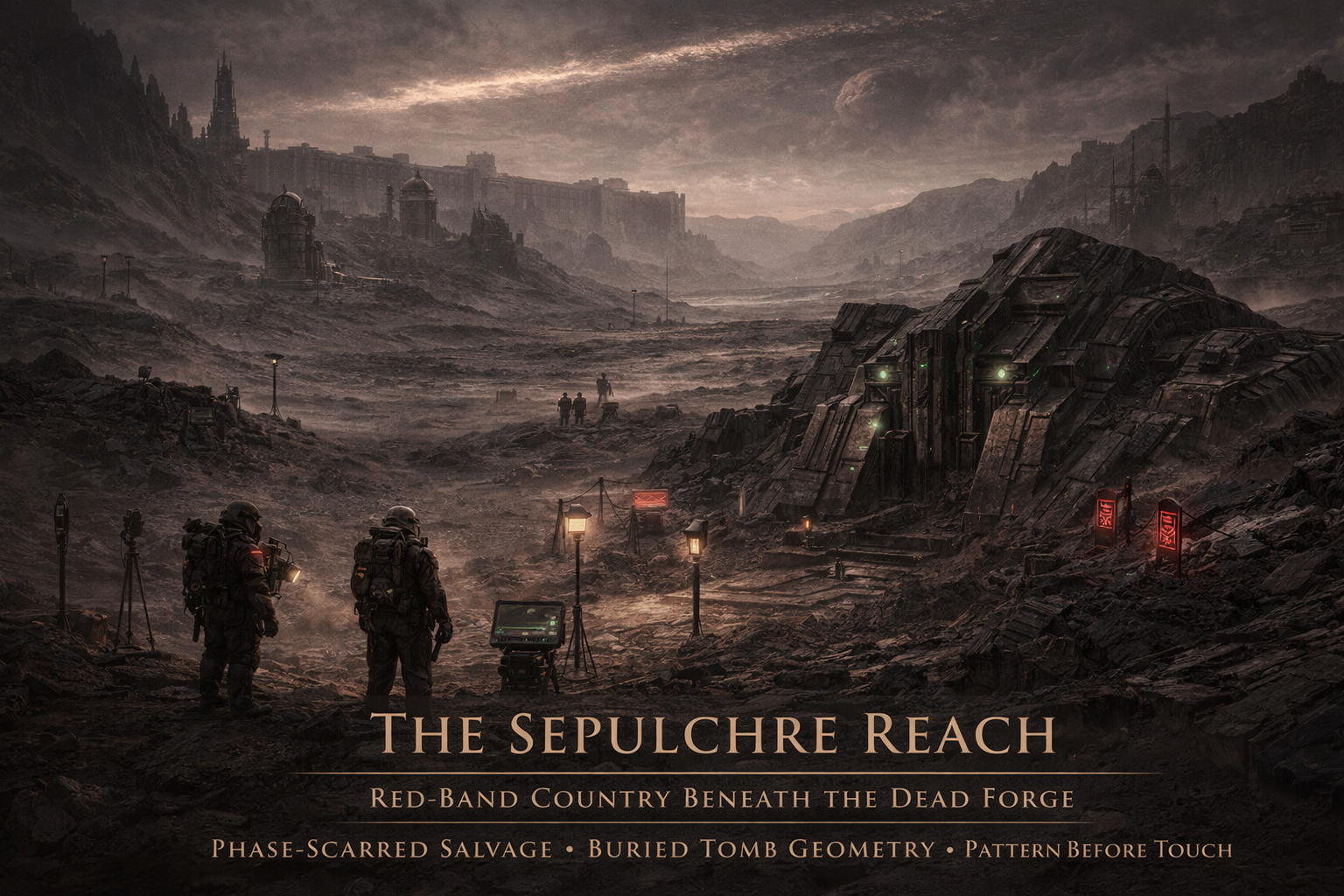
The Sepulchre Reach
Shepherd Crossing the Arc
Hypnoth and Vôrun Hold at working distance
Hypnoth is not a world of promise. It is a world of remainder.
It turns beneath the pale authority of a K-dwarf sun, heavy in its own gravity, scarred by old industry and older war, with a ten-hour day that gives neither flesh nor machine much time to soften. Once it was a Forge World of the Imperium: a place of foundries, pressure towers, assembly corridors, crucible basins, and industrial mass so vast that it could be seen from orbit not as cities, but as a second geology laid over the first. Then came the siege. The lines broke. The defenders died. The manufactoria collapsed into blackened strata. Reactor fields poisoned themselves. Tomb-complexes slumbered uneasily beneath the wounded crust. The Imperium, having broken the world and been broken upon it in turn, left it behind. The records did not forget Hypnoth. They did something far worse. They learned to classify it as not worth the trouble.
That, in the end, was why the Kin stayed.
To the Kin of Vôrun Hold, Hypnoth is not a dead world in the poetic sense. It is not a mausoleum, not a myth-site, not a cursed jewel waiting for rediscovery. It is a ledger left open. Its value lies not in what it dreams of being again, but in what it still contains: pressure-stable alloys buried in collapsed hullworks, dead forge hardware locked in vitrified belts, ceramic shielding in poisoned calderas, assembly skeletons leaning like the ribs of extinct giants, and beneath all that, archives, machine bodies, transit spines, sealed vaults, and rarer things that remain useful only so long as they are handled with sufficient fear. Hypnoth is not rich in hope. It is rich in recoverable structure.
A world built around weight
The first truth of Hypnoth is gravity.
The archive establishes Hypnoth as a dense, compact world: 1.6 Terran masses, 1.1 Terran radii, with a surface gravity of roughly 1.3g. It circles the system’s K-dwarf primary at 0.75 AU, completing a year in 257.32 Terran days, while rotating once every ten hours. Two moons remain in orbit, and the debris of a destroyed third moon survives as the Arc — the pale ring that has become one of the defining features of the world’s sky.
Those numbers matter because they shape the feeling of the place. Hypnoth is not broad, loose, or generous. It is compact and iron-heavy. Weight is culture there. Machinery must be overbuilt. Transit is expensive. Towers cannot be elegant for long; they must justify every meter against their own mass. Structures that would be merely immense elsewhere become thick-boned necessities on Hypnoth. The surviving architecture does not rise lightly. It hunkers. It digs in. When it collapses, it does not make picturesque ruins. It makes terrain.
Underfoot, the world is hard in a way only metal-rich planets should be hard. Hypnoth is best understood as a wounded core-world: an oversized nickel-iron heart, a mantle scarred by ancient extraction and bombardment, and a crust that no longer behaves like healthy skin so much as a repeatedly broken plate. Even its ash feels structural. Even its dust feels like something ground down from older purpose.
The old bones of Hypnoth
Hypnoth is best imagined as a world with ancient tectonic bones and a presently sluggish lithosphere.
In its deep past, it almost certainly knew active tectonics: shield-building, mountain raising, mantle upwells, crustal sutures, all the long violence that gives a rocky world its first continents. But that was before the age of the forge. Before extraction on a civilizational scale. Before bombardment, vitrification, and the repeated thermal shock of industry layered over geology until the surface itself became an engineered scar.
Now the crust is not dead, but wounded. It moves reluctantly. Stress localizes along old sutures, impact basins, overburden scars, and the roots of ancient excavations. Seismic events do not announce a healthy living world below. They announce a world still remembering pressure.
That gives Hypnoth three great physiographic realities.
The first is the Anvil Continent, the oldest and most stable cratonic body on the planet, rich in deep metal provinces and burdened with the earliest forge foundations. The oldest industrial conquest of Hypnoth took place here because the ground could carry it.
The second is the Sepulchre Reach, a fractured shieldland where older tectonic breaks, buried tomb strata, and Mechanicum overbuild came to overlap in the worst possible ways. Here the geology is not merely broken. It is contested by incompatible histories.
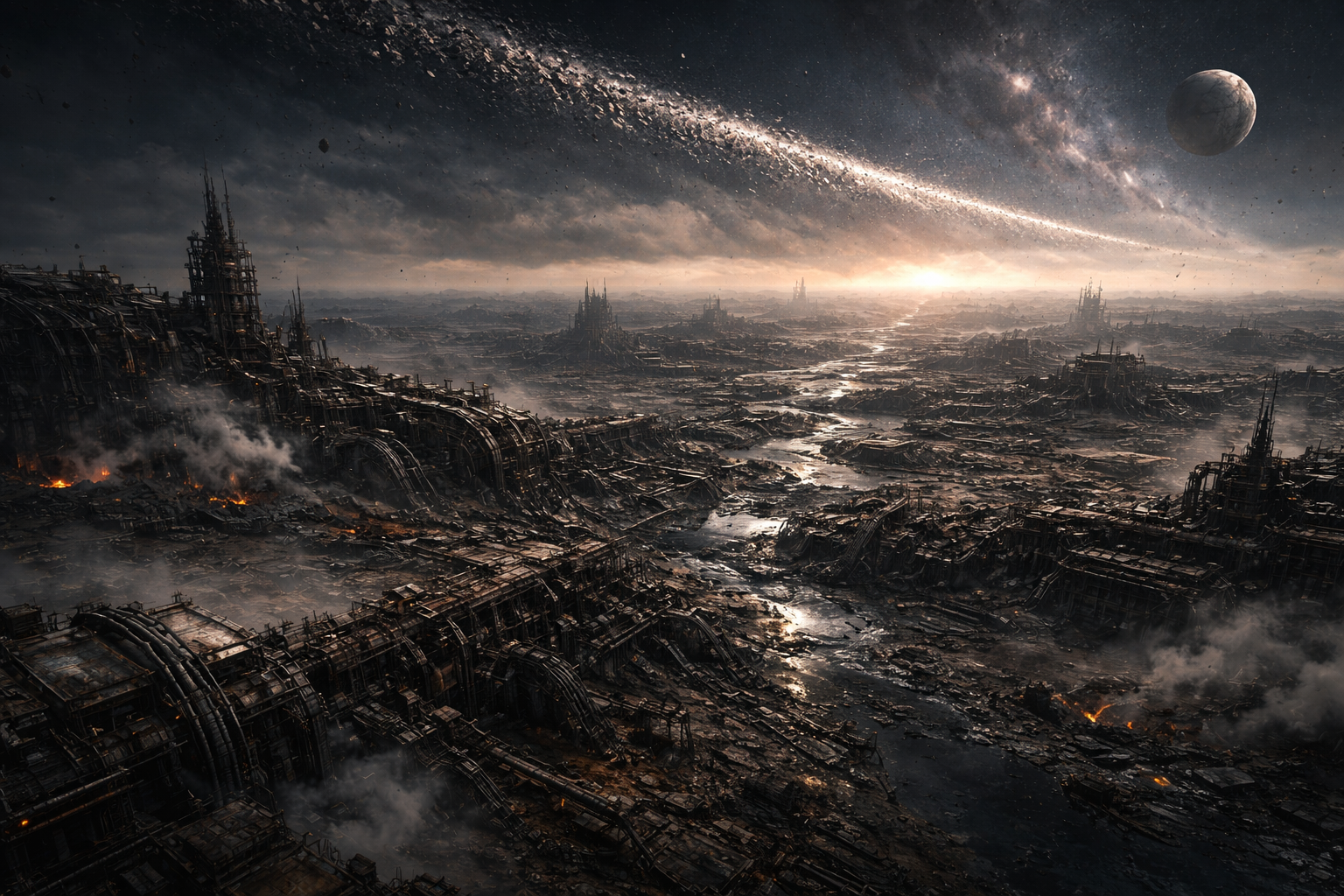
The third is the Glass Meridian, not a continent in the classical sense but a near-equatorial industrial belt so vast that it functioned as one. Here the forge-world phase of Hypnoth overrode geology most completely. Manufacturing corridors, conveyor spines, pressure yards, foundry fields, cooling plains, crucible sinks, and transit hubs once formed a man-made girdle around much of the globe. War did not erase it. War vitrified it. From orbit it remains visible as a darkened wound around the planet.
The visible face of the world
Hypnoth is not red like Mars, nor silver like a sterile moon, nor black in any simple volcanic sense. Its palette is industrial and bruised: iron-grey ash, green-black furnace glass, oxidized bands of brown and orange, pale dust over dark slag, reflective scars of fused silica, and the occasional bone-white exposure of ceramic shielding where wind has stripped the top layers away.
On some horizons, refinery towers still lean in clustered thickets, their piping tangled and ruptured, catching dawn light in broken lines. Elsewhere, half-buried assembly gantries lift out of the plains like the vertebrae of some mechanical leviathan. The site’s existing Hypnoth material already gives this visual signature directly: collapsed refinery piping, half-buried assembly gantries, dead reactors, and manufactoria cut down into cargo and lifted into orbit.
A walker crossing Hypnoth should feel the world through the soles first. Furnace-glass cracks under boots. Metallic dust clings to seals and hinge-lines. Old slag shines like water until the eye corrects. There are places where the ground rings dully because a floor lies beneath a floor, and others where a crust only centimeters thick covers a sink of pulverized machine debris. In some sectors, ancient hazard sirens still moan when crosswinds strike broken stack-mouths. In others, static crawls on the teeth before vox interference blooms and depth-auspex begins to lie.
That distinction matters. On Hypnoth, the boundary between landscape and wreckage was erased long ago.
The Great Regions of Hypnoth
The Glass Meridian
If Hypnoth has a defining scar, it is the Glass Meridian.
This is the great visible wound of the world, the forge belt that became a geological feature. Vast stretches of it are vitrified: plains of black-green glass, pressure-cracked cooling beds, fused machine foundations, and endless bands of collapsed industrial mass. During daylight, the surface can glare with a hard metallic sheen. By night, some sectors still bleed stored heat slowly back into the dark. Vôrun crews prize the Meridian for what they call heat-dead salvage: structurally reliable remains from furnace-killed industry, quiet materials that no longer answer in surprising ways.
The richest parts of the Meridian are not dramatic throne-halls or ceremonial ruins, but process architecture: pressure manifolds thicker than hab-blocks, conveyor ribs that once moved mountains of feedstock, shielding casements, furnace jackets, crucible collars, and the frame-bones of macro-foundries. Conservative Brôkhyr crews tend to prefer this country. In the language of the Hold, heat-dead is honest.
The Anchor Mountains
The Anchor Mountains are the oldest lie on Hypnoth: from a distance they resemble a natural range, dark and immense beneath the Arc, all broken ridgelines and ash-choked escarpments, but no true geologist or Brôkhyr would ever mistake them for ordinary stone. They are the fused roots of Hypnoth’s orbital age — the buried foundations of mass-launch towers, tether collars, gravitic anchor complexes, and elevator spines driven so deep into the crust that when the world died, they did not fall cleanly. They collapsed inward, folded into one another, vitrified, buckled, and endured.
What remains now is engineered geology: mountain-scale buttresses of iron-black rock and machine metal, cliff faces veined with reinforcement ribs, and valleys where the ground rings hollow because an older structure still survives beneath it. Whole ridges are made from compression collars broader than fortresses. Ravines open into broken launch wells and transit shafts. Exposed faces show repeating geometries too regular to be natural — pressure-braced galleries, anchor plates fused into basaltic flows, and the petrified remains of lift-spines that once hurled mass from the forge world to the void.
This is deep-salvage country. Anchor-Mountain crews work slowly, under load and under seal, cutting into old pressure roots, mapping buried chambers, bracing forgotten hollows before they open them, and hauling out gravitic clamps, stabilization rings, void-rated collars, launch braces, and machine architecture of extraordinary utility. The returns are immense. So are the risks. Collapse is common. Old fields still wake without warning. Vox dies in the wrong galleries. Some shafts descend past forge strata into older dark, where the mountain stops being Imperial and the geometry beneath begins to answer in ways no prudent crew enjoys.
The Ash Dorsae
The Ash Dorsae are the long grey backs of Hypnoth: ridges and trough-fields of iron ash, powdered slag, conductive dust, and ground machine residue running for hundreds of kilometers across old tectonic folds and dead industrial plains. They do not dominate the eye the way the Meridian does, nor do they carry the brutal grandeur of the Anchor Mountains. At first glance they seem lesser country: flat, wind-scoured, and poor in spectacle. That is why strangers misjudge them.
The Ash Dorsae are working land. They are the patient geography of distance, concealment, attrition, and route.
Their surface is never still. Wind moves the upper skin of the Dorsae constantly, drawing the ash into low dunes, knife-backed ridges, shallow wave-forms, and long dark streamers that can erase yesterday’s tracks by the next dim cycle. In some places the ash lies soft over buried metal and rings hollow underfoot. In others it has sintered into a brittle crust that cracks like old ceramic and reveals older strata beneath: conveyor beds, cable trenches, culvert mouths, and the broken crowns of half-buried relay towers.
The dust itself is one of the region’s greatest hazards. It clings to seals, creeps into hinges, fouls intakes, and under certain conditions carries enough static charge to make augurs uncertain and vox traffic coarse with hiss. A Kin can read a bad wind in the Dorsae by taste alone — iron, old carbon, and the faint machine bitterness of ground refractory.
This is route-house country. Survey Kin, Hernkyn, and long-haul salvage houses value the Dorsae because what looks empty here is often navigable, and what looks rich is often a trap. The best overland passages between greater salvage regions run through the Dorsae. Convoy staging grounds hide in their lee-basins. Marker pylons stand where no natural landmark should, half buried and blackened by abrasion. A good Dorsae guide learns to read not the horizon, but the interruptions in it — the line too straight, the ridge too regular, the dust-shadow that means a buried void below.
The Crucible Sinks
Where foundry districts, bombardment, subsidence, and thermal collapse combined, the surface dropped into enormous depressions. Some are broad shallow basins of broken ceramic and ash. Others are steep-walled wounds lined with vitrified runnels and half-melted infrastructure. These are the Crucible Sinks: graveyards of heat and industry.
Atmospheric haze clings there. Rad budgets rise unpredictably. Yet the returns can be extraordinary. Buried within the sinks are furnace hearts, refractory shielding, process cores, pressure-stable alloys, and the husks of reactors too dangerous to leave untouched and too valuable to ignore. The Crucible Sinks are not treasure pits. They are industrial wounds still hot with consequence.
The Sepulchre Reach
If the Glass Meridian is Hypnoth’s scar, and the Anchor Mountains its load-bearing memory, then the Sepulchre Reach is the place where the world becomes uncertain beneath the feet.
This is where old continental roots, dead basins, uplifted industrial plains, forge overbuild, and tomb strata all lie too close to one another. Here a conveyor trench may terminate not in collapse, but in geometry too exact to belong to the world around it. A plateau may be half vitrified refinery platform and half sealed lid over something that never belonged to the Imperium at all.
That is what makes the Reach dangerous. Not spectacle. Not heat. Not even radiation, though there is enough of that in certain cuts and hollows. The true danger of the Reach is relation. Things connect wrongly there. Distances feel true until measured twice. Repeating angles appear in places where no repetition should survive. Marker lines drift from expected north and then return as if nothing happened. A poor crew may enter a ruin expecting dead machinery and instead find a space whose proportions unsettle auspex, whose walls refuse honest echo, and whose floor plan remains simple only until the point where the mind tries to remember it afterward.
From afar, the Reach can look disappointingly plain. That is one of its cruelties. Much of the region is made of low broken plateaus, ash-dulled plains, half-collapsed industrial districts, and dry channels cut by ancient runoff or later excavation. Yet the ground carries a different quality. It does not feel dead in the comfortable way dead forge country can feel dead. It feels withheld.
This is Red-Band country. Pattern-before-touch country. Dual-sign-or-no-sign country. The teams that work here are not bold in the theatrical sense. They are slow, exact, and professionally suspicious. Durn Khel’s influence is strongest in this region, not because his crews seek marvels, but because he understood before most others that the value of such places lies not in trophies but in useful geometry stripped from foreign relation and only then bound back into Kin-safe material. Even so, the Reach has taught Vôrun again and again that usefulness is not innocence.
Climate and weather
Hypnoth is not a living climate world. It is an industrial climate world.
At 0.75 AU around a lower-luminosity K-dwarf, it receives less insolation than Earth. Add a fast ten-hour day, vast low-albedo industrial belts, dust-heavy plains, centuries of atmospheric abuse, and a surface designed more for extraction than for ecology, and the result is a climate best described in operational terms rather than pastoral ones.
There are no meaningful seasons in the soft human sense. There are windows.
Cold windows. Dust windows. Glare windows. Ring-bright nights. Ash storms low to the ground. Thermal whiplash between daylit vitreous plains and shadowed trenchworks. Some sectors retain heat with unnatural persistence because of buried infrastructure and dark surface materials. Others shed it brutally and become iron-cold after sunset. In depressions, industrial haze and poison residues can pool. In the Meridian, black surfaces drink light and return it late. In the Dorsae, winds move conductive dust in long low veils that make even good optics suspicious.
And above all of it hangs the sky-story of Hypnoth.
The sky above Hypnoth
The archive gives Hypnoth two surviving moons and the ringed debris of a third. The inner moon, Shepherd, orbits at 60,000 km with a period of roughly 32.1 hours. The outer moon circles at 250,000 km with an 11.4-day period. The destroyed third moon once orbited farther out, but tidal disruption carried it down near the planet’s Roche threshold, leaving behind the long-lived debris structure now known as the Arc.
This means the sky of Hypnoth is not decorative. It is infrastructure.
The Arc is not a delicate ribbon. It is a scar. From some latitudes it hangs as a pale blade across the heavens. From others it broadens into a band of filings and dust. Shepherd’s crossings matter. Light levels change. Salvage timing changes. Schedules and superstition overlap. The archive even notes the transit effect known from Vôrun’s perspective as Shepherd’s Cut, where the moon can dim the primary star significantly for a short interval. That is the sort of hard astronomical detail that gives the world authority.
From the surface, when the light is right, Shepherd seems almost surgical: a moving stone that slices the Arc into brightness and shadow. The Far Moon feels different — slower, darker, less intimate, more witness than clock. Together with the Arc, they make Hypnoth a world that never feels unaccompanied.
Why the Kin chose Hypnoth
This part matters enough to say plainly.
The Kin did not choose Hypnoth because it was glorious. They chose it because it was measurable, useful, and unattractive to everyone else.
The existing Vôrun lore already states the strategic truth cleanly: Hypnoth was too costly to reclaim and too haunted to contest. It carried mechanophage history, dormant tomb-complex risk, and little reason for a major outside power to invest the ruinous resources required to restore it. Vôrun-Hold, by contrast, was built precisely for continuity under pressure: continuity loads first, structural loads second, productive loads third, with every system designed to fail slowly and be corrected before catastrophe. That is the exact mentality required to make use of a world like Hypnoth.
The Kin saw that Hypnoth offered not merely ore, but processed value. It offered centuries of already-worked industrial mass: rails, clamps, braces, furnace collars, bulk shielding, machine bodies, survey arrays, transport spines, archives, and void-interface hardware. It offered low competitive pressure because its administrative status was cold. It offered danger, yes, but danger that could be zoned, priced, and worked around.
In a galaxy where most powers prefer worlds that flatter their mythologies, Hypnoth offered Vôrun something better: a claim that could be made to endure.
That is the sentence at the heart of the planet:
Hypnoth was chosen because it promised centuries of recoverable structure under conditions too ugly to invite competition.
The experience of walking Hypnoth
To walk Hypnoth is to move through the carcass of an industrial civilization so vast that even ruin has hierarchy.
A salvage team descends in the long light beneath the Arc. The lander’s thrusters kick glass dust into glittering sheets. Ahead, a field of collapsed refinery spines leans against the horizon. To the left, assembly gantries rise from the earth like broken ribs. The vox is clear until it isn’t. Metallic dust works at every seal. The ground under the first few steps is firm, then hollow, then firm again. Somewhere wind moves through a cracked siren throat and makes a sound like a mechanical animal trying to remember speech. Overhead, Shepherd is a bright wound in motion.
And then the work begins.
Not treasure hunting. Not archaeology for its own sake. Work.
Cutting dead reactor jackets into carryable sections. Logging ceramic shielding. Bracing a buried transit rib before the haulers lift it. Marking a sink-mouth black because its geometry repeats too neatly. Taking structure, not temptation. Returning with mass, data, and the kind of silence that tells the Hold the numbers were not clean.
That is Hypnoth.
Not a graveyard. Not a mystery box. Not a throne for a lost empire.
A world where matter outlived meaning, and where the Kin came anyway, because even now, under ruin, the world still holds.