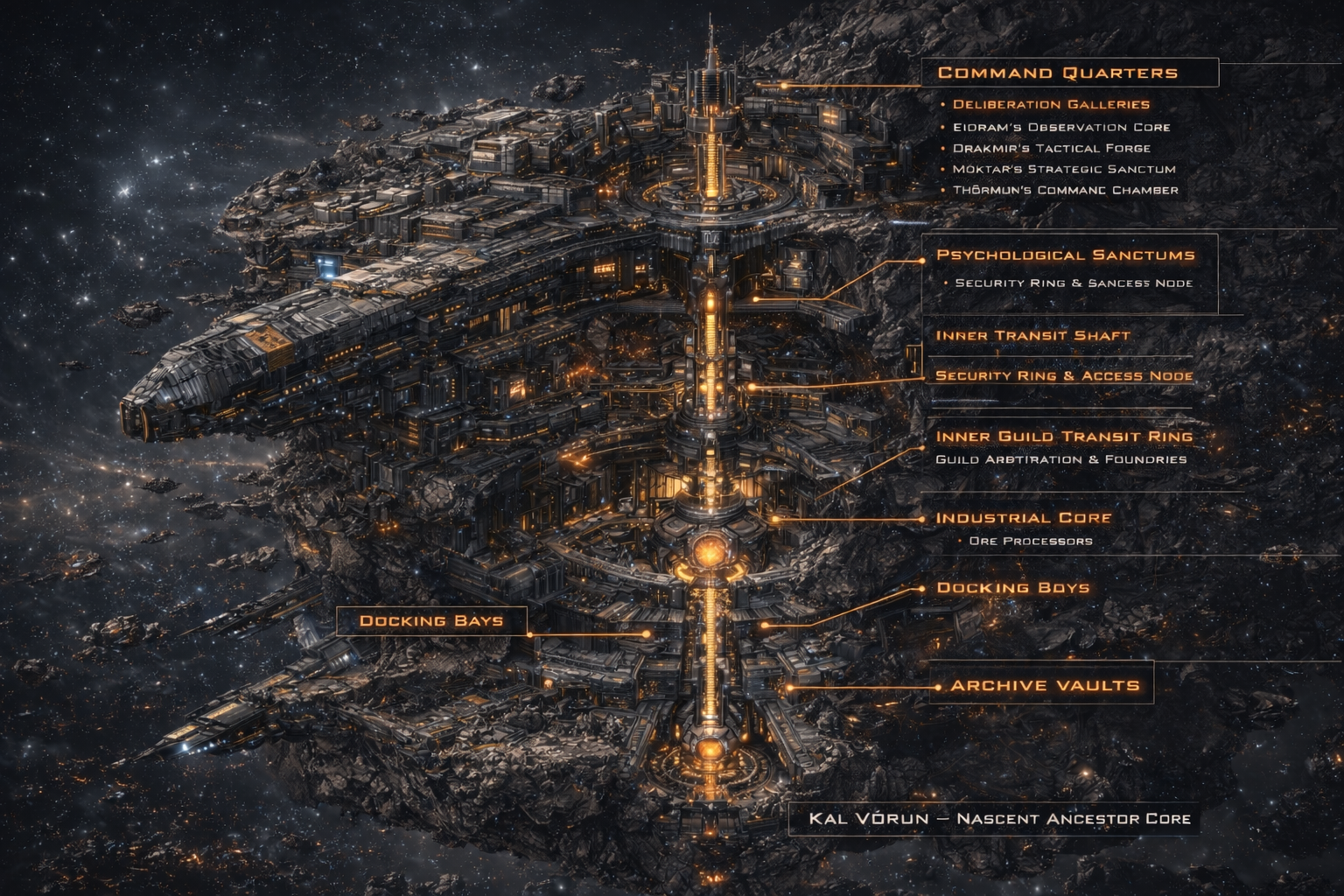
Vôrun Hold - Command and spine
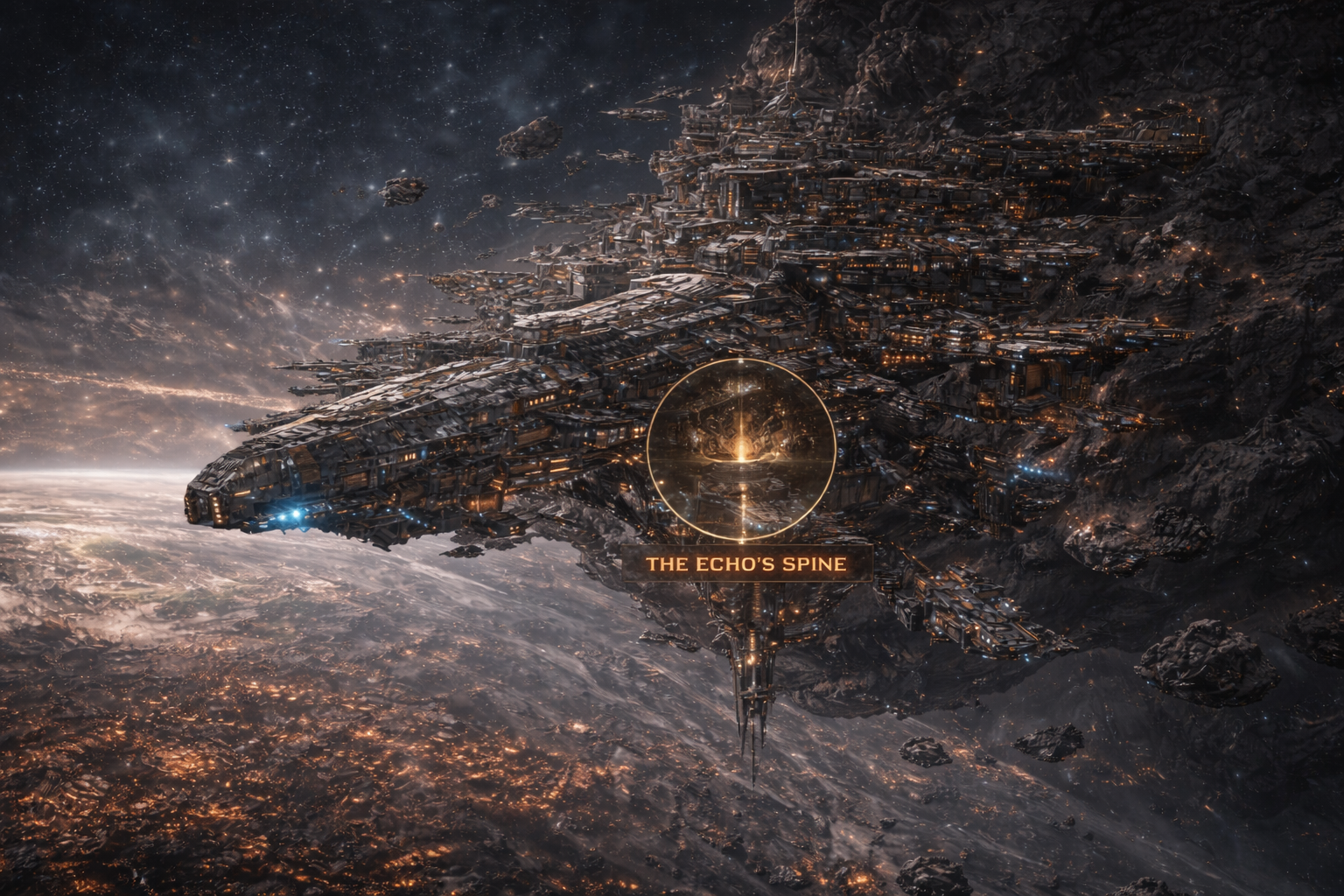
THE ECHO’S SPINE
The Command Quarters of Vorun Hold
Deep within the fused hull of Örgvayr’s Echo, buried beneath kilometers of asteroid rock and alloy reinforcement, lies the cognitive heart of Vorun Hold.
It is not a throne room.
It is not a cathedral.
It is not a sanctuary of worship.
It is where decisions survive scrutiny.
This is The Echo’s Spine.
LOCATION — THE BURIED AXIS
When Örgvayr’s Echo was entombed into the asteroid that became Vorun Hold, its command deck was not preserved as a relic. It was broken open, reinforced, and built through.
The Echo’s Spine now sits directly behind that original bridge — deep along the structural axis where ship meets stone.
From orbit, it cannot be seen.
From within, it cannot be reached casually.
It is accessed through:
The Inner Guild Transit Ring
A sealed Security and Access Node
A single Vertical Transit Shaft descending through armored strata
Every corridor narrows as one approaches it.
Every threshold requires authorization.
Every door remembers who passed through it.
The closer one moves toward the Spine, the quieter the Hold becomes.
ARCHITECTURE — STRUCTURE AS PHILOSOPHY
The Echo’s Spine is built vertically.
Not for spectacle — but for clarity.
A central shaft runs downward like a spinal column. Around it are concentric functional rings:
Upper Ring – Command Quarters
Mid Ring – Deliberation Galleries
Lower Ring – Archive Vaults
Core Chamber – Kal Vôrun
There are no wide ceremonial halls. No ornamental excess.
Everything is load-bearing. Everything has purpose.
Walls are matte alloy and carved stone, etched with lineage runes not for reverence — but for indexing.
Doors are thick, segmented pressure slabs with recessed seam-lines.
They open silently. They close definitively.
Light is warm but indirect — projected through vertical conduits that trace the spine itself.
The entire space hums at a low harmonic frequency — Kal’s processing rhythm diffused through structure.
LEVEL BY LEVEL — HOW THE SPINE FUNCTIONS
I. THE COMMAND QUARTERS
This is where the primary actors of Vorun Hold reside when not in the field.
Each chamber is sparse, deliberate, and psychologically calibrated.
High Kâhl Thôrmun Vôrrek
Thôrmun’s chamber is austere.
A central table.
A wall of tactical projections.
A single archive interface.
He does not decorate with victories.
He does not display trophies.
When he uses the Spine, he walks it slowly.
He pauses before speaking in deliberation.
He listens first to Kal’s weighted outputs.
Then to Eidram’s pattern analysis.
Then to Drakmir’s ground-truth assessment.
Only then does he contribute.
He uses the Spine not to dominate — but to moderate.
His role here is not authority.
It is equilibrium.
Eidram Vôr — The Mem-Engine That Watches
Eidram rarely stays still within the Spine.
She moves between:
Archive Vault interfaces
Deliberation overlays
Observation balconies above the core
She uses the Spine as a relational instrument.
When council convenes, she does not speak immediately.
She tracks:
Tone shifts
Linguistic divergence
Historical inconsistency
Logical compression points
Her voice enters only when pattern tension reaches threshold.
She uses Kal not as a master — but as a comparison engine.
If Kal’s conclusion narrows too quickly, she expands context.
If debate drifts into abstraction, she anchors it in record.
The Spine sharpens her.
She sharpens the Spine.
Kâhl Drakmir — The Blade Made Accountable
Drakmir does not enjoy the Spine.
It is too still.
Too reflective.
But he respects it.
When he arrives from Vôrun’s Wall, he carries live battle logs, casualty metrics, and field irregularities.
In deliberation he does one thing consistently:
He forces projection to meet consequence.
If Kal predicts optimal outcome, Drakmir asks:
“At what cost?”
If Môktar proposes aggressive positioning, he asks:
“How many Kin do you trade for that angle?”
He uses the Spine as friction.
Without him, it becomes theoretical.
With him, it remains grounded.
Môktar Vôrunsdottir — The Hammer Held in Reserve
Môktar uses the Spine differently than any of them.
She treats it as a shaping tool.
She walks the circular gallery while projections spin.
She challenges Kal’s assumptions deliberately.
She reframes tactical maps as geometric evolutions.
She is not reckless.
She is catalytic.
If Kal leans toward precedent, she introduces disruption.
If Thôrmun seeks balance, she pressures edge-case possibility.
If Eidram maps pattern continuity, she probes discontinuity.
The Spine does not restrain her.
It refines her.
II. THE DELIBERATION GALLERIES
Circular. Elevated. Encircling the central shaft.
This is where final arguments are made.
Holographic projections rise from the floor in geometric lattices — battlefield simulations, resource allocation streams, diplomatic branching probabilities.
Kal Vôrun’s voice is not audible here in the traditional sense.
It manifests as:
Light shifts
Weighted data prioritization
Statistical tightening
Scenario ranking
No decision is rushed.
Silence is common.
Silence is productive.
When a conclusion is reached, it is recorded immediately into the Archive Vaults below.
No decision in the Spine vanishes.
III. THE ARCHIVE VAULTS
These are not dusty repositories.
They are active data strata.
Physical memory banks, crystalline cores, neural lattice spines.
Eidram interfaces here most often.
Kal’s deeper memory threads are anchored here.
When conflict arises in deliberation, the debate often descends here.
In the Vaults, memory is not narrative.
It is structured precedent.
Sometimes, anomalies surface.
Fragments of refugee lineage trauma.
Incomplete battle sequences.
Data compression scars from Örgvayr’s final days.
When that happens, the Spine grows tense.
Because memory is guidance — but memory can fracture.
IV. THE CORE CHAMBER — KAL VÔRUN
At the lowest point of the Spine rests the Nascent Ancestor Core.
Kal Vôrun is not enthroned.
It is integrated.
Cabling runs upward into the central shaft.
Light pulses at slow intervals.
Processing arrays shift subtly as input changes.
No incense.
No ritual chanting.
No reverence.
Kal is consulted.
Interrogated.
Challenged.
Thôrmun does not bow before it.
Drakmir does not defer to it blindly.
Môktar deliberately pressures its projections.
Eidram audits its memory weighting.
Kal Vôrun is not worshipped.
It is held accountable.
And in that accountability, Vorun survives.
HOW THE SPINE SHAPES VORUN HOLD
Every major directive passes through this chamber.
War mobilization.
Guild arbitration.
Resource reallocation.
Diplomatic recognition.
The Outer Docking Rings feel the effect hours later.
The Industrial Core shifts output days later.
Vôrun’s Wall repositions fleets weeks later.
All because of a decision compressed and forged in this vertical axis of alloy and stone.
If the Spine fractures, Vorun fractures.
If trust within it erodes, the Hold destabilizes.
It is not a throne room.
It is a pressure chamber.
And inside it stand:
A founder who seeks balance.
A mem-engine that watches.
A blade that demands consequence.
A hammer that shapes possibility.
And a ledger that waits.