Indexed Silence
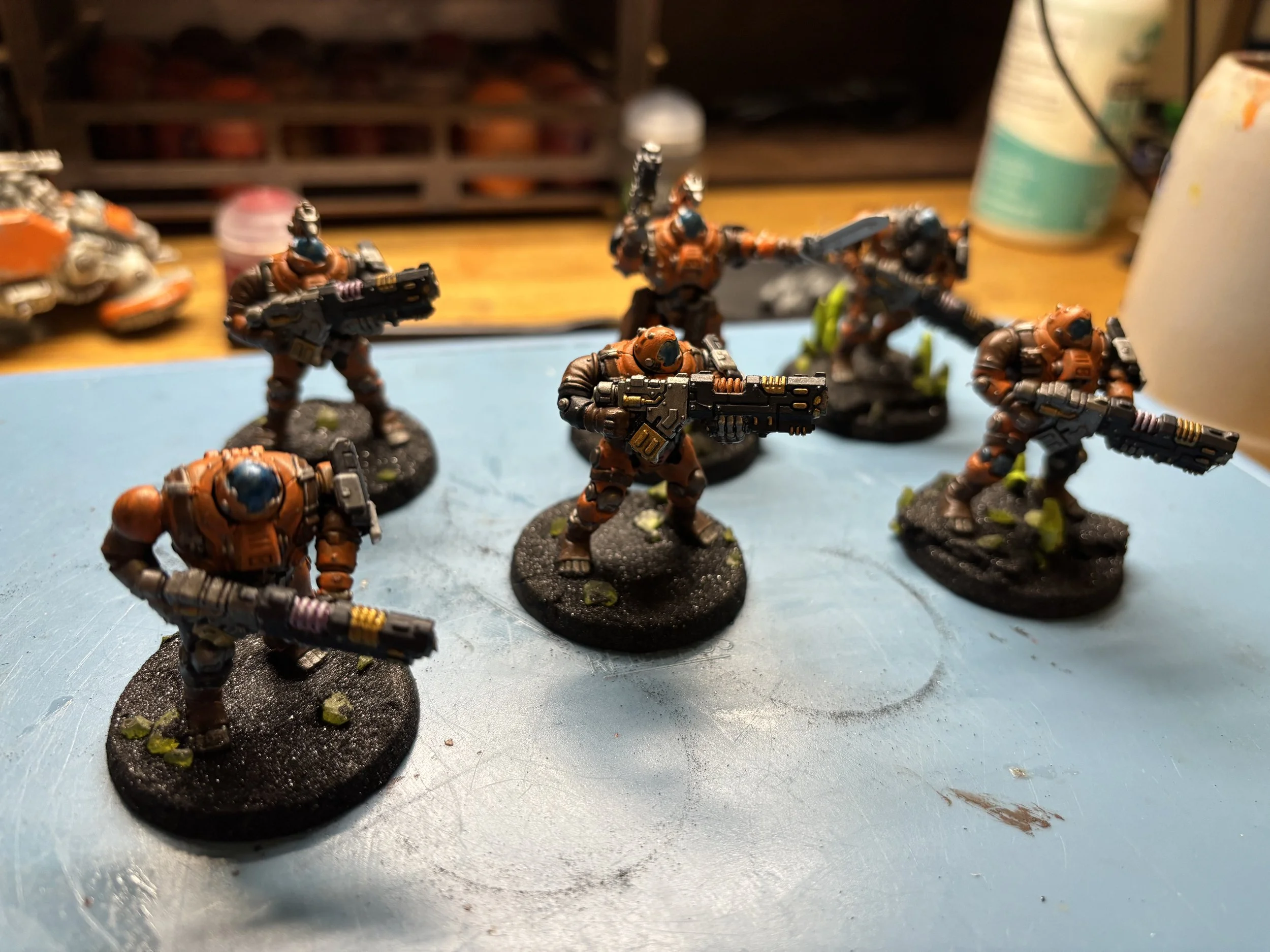
Indexed Silence
Steel at the Outer Margin
They were present before Vôrun was a Hold.
Before the first chambers were cut. Before the anchor-lines were sunk. Before intake routes were measured and named. Before the Spine had hardened into habit. They stood below-decks in the descent phase, mass-heavy and idle, awaiting instruction while fracture engineers argued bore angle, reinforcement depth, and the first acceptable violence to be done to Hypnoth.
They were ready to cut.
That has remained true ever since.
Indexed Silence is not counted among the honors of Vôrun. It is counted among the costs the Hold is willing to accept when softer measures have already failed. They are Steeljacks of the Vidar Compact line: exterior continuity constructs first assembled for anchor descent, hull opening, and structural custody, then retained because the same logic that makes a construct useful in settlement makes it indispensable in war.
In Vôrun, battle is not separate from continuity. It is what continuity becomes when pressure exceeds tolerance.
Their maxim is old and still correct:
Volume reveals the fault.
Outsiders often misunderstand this. They hear aggression. Saturation. Brute force without elegance.
That is not Vôrun’s meaning.
In Vôrun, volume is not noise. It is proof applied without interruption. Armor does not fail because Indexed Silence seeks spectacle. Stone does not crack because Steel wishes to be feared. Sustained beam, repeated burn, pressure held past comfort — these reveal where strength had already been spent before contact.
Their fire is not prized as destruction.
It is valued as confirmation.
That is why the cohort is called Indexed Silence.
The index is the point. Not the construct. Not the weapon. Not the tally. Each deployment is logged against a structural deficit, an escalation threshold, and a continuity cost borne elsewhere in the Hold. Silence is the result once uncertainty has been burned away. When Indexed Silence opens fire, argument ends. Not because the battlefield grows quiet, but because the fault has been made visible.
They were not designed for victory.
They were designed for custody.
The first Steeljack frames of Vôrun were adapted from descent and hull-work patterns used during the settlement of Hypnoth. Their shoulders were widened to bear temporary brace-rigs against unstable cuts. Their anchor-feet were built to hold on fractured surfaces under failing grav compensation. Their arms were balanced not for ceremony or duel-work, but for load transfer, plate separation, and heat-directed disassembly of dead structure fused into the outer shell of Örgvayr’s Echo.
When Volkanite was later fed into those same lineages, the change was less dramatic than later generations liked to pretend.
The tools deepened.
The purpose did not.
A Steeljack cohort is committed when recovery is no longer the governing question.
That distinction matters inside Vôrun. Flesh is still sent where retrieval remains plausible. Ironkin are still tasked where judgment, adaptation, or measure must remain open. Hearthkyn and void-teams still go where a corridor, chamber, or outer plate might be held, reclaimed, or worked around.
Steel is posted only when the matter has already crossed into structural truth.
When an aperture must be denied.
When a breach must hold regardless of protest.
When intake must be brought under custody before claim.
When selective sealing has been approved, and survivability outranks sentiment.
This is why the release of Indexed Silence is never treated lightly by the Spine.
Their deployment is felt in the Hold before embarkation is complete. Exterior patrol intervals widen. One vault gantry falls to reduced readiness. A shaft reinforcement queue extends beyond acceptable comfort and is tolerated anyway. Cargo movement through an outer cradle becomes more dangerous for a shift, then for two, because the Steel normally posted there is absent.
Durn signs the maintenance loss.
Eidram marks the variance.
Thôrmun approves release only when the larger failure has already been measured and accepted.
In Vôrun, nothing load-bearing goes to war without leaving a scar behind.
This is one reason Steeljacks are publicly visible in the Hold. They are not hidden in sanctums like relics, nor sealed away as esoteric war-assets. They are seen in dock light and shaft dusk, in radiation wash and cold gantry shadow, because their role has always been civic before it is martial. They reinforce hull-ribs. They stand on the Pale Lintel during pressure loss. They lock themselves into place beside compromised seams while Kin evacuate through routes too narrow or unstable for ordinary cover screens to matter.
Children of the First Cycle learn their silhouettes before they learn the names of most ships.
Not because they are loved.
Because they are present when the wall is under question.
Their orange paneling is not heraldry.
The color predates any parade language in Vôrun. It descends from breach-visibility and descent marking used during the earliest Hypnoth cutting operations, when constructs moving along unfinished outer surfaces had to be read instantly by dock crews, Cthonian teams, and line engineers under poor light and failing systems.
The orange remains because it still saves time.
A Steeljack bracing a lock during decompression does not need to look noble. It needs to be seen, identified, and worked around without hesitation.
In Vôrun, visibility is a form of efficiency.
Beauty enters later, if at all.
Among dock crews, the language around Indexed Silence is spare. They do not speak of the cohort in terms of kills, glory, or feats of machine courage. Those are soft metrics. They ask other questions.
How long did Margin Section hold?
Was Vault Section posted before the seal collapsed?
Did Gantry Section keep the line open through second breach?
How many hours did Steel take the weight?
This is how Steel is remembered in Vôrun: not by what it slew, but by what remained standing after flesh had already withdrawn.
Their battlefield work follows the same logic.
When Indexed Silence is deployed in open war, they are rarely placed where the enemy is merely dangerous. They are sent where danger has become geometry. A hostile vehicle line pressing through mined stone. An ork ram-column relying on momentum rather than cohesion. A bastion held together by confidence and poor welding. A Tyranid pressure wave bunching too tightly in a corridor that cannot absorb its own mass. A void approach that looks stable until sustained heat turns hidden stress into visible collapse.
Their role is not to dominate the horizon.
It is to stand where pressure gathers and prove what part of it was never sound.
This is also why certain commanders in Vôrun value them differently.
Durn values Steeljack cohorts as externalized margin: reusable structural assets that can hold a problem still long enough for the correct failure to be chosen.
Keln values them because they make time material. A corridor held by Steel is measured in hours gained, routes preserved, withdrawals made clean rather than desperate.
Moktar values them because they allow Vôrun to spend mass instead of blood where blood would be wasteful.
Drakmir respects them, but distrusts overreliance on any answer that becomes predictable by posture alone.
Thôrmun treats their deployment as an admission that the matter has passed beyond preference and entered necessity.
All of these views are true.
None of them are sentimental.
Indexed Silence has no ceremonial place at feasts. No saga-niche of its own. No special memorial rite apart from the ordinary ledger entries governing loss, damage, duration, and replacement.
This too is intentional.
Vôrun does not anthropomorphize Steel because doing so would weaken the reason Steel exists. They are not Kin. They are not heroes. They are the shape continuity takes when mercy has narrowed and the line must remain load-bearing whether or not anyone wishes it to.
Yet they are not treated cheaply.
Each cohort-frame carries descent lineage traceable to the first settlement cuts into Hypnoth. Their chassis marks retain anchor and custody indexing derived from early Compact protocols. Certain machine habits, stance calibrations, and heat-routing preferences still descend from those first operations, when survival was not yet a philosophy but an immediate engineering problem.
To maintain a Steeljack in Vôrun is to maintain a piece of founding logic in motion.
Not sacred logic.
Worse than sacred.
Useful logic.
That is why damage to a Steeljack is recorded in two ledgers.
The first is material: armor loss, actuator stress, weapon degradation, replacement burden, repair hours.
The second is structural: what absence must now be tolerated in the Hold because this frame is no longer available for custody work.
A damaged Hearthkyn can be mourned and replaced only badly.
A damaged Steeljack creates a different wound.
Somewhere in the outer shell, one answer becomes unavailable. Somewhere in a shaft, one reinforcement window narrows. Somewhere in a dockside calculation, tolerances once held by Steel must be handed back to flesh.
Vôrun does not confuse those losses.
It honors neither by pretending they are the same.
In the old intake language of the Hold, there is a phrase still used by crews working the exterior dark:
Silence is posted.
It does not mean the area is secure.
It means security has ceased to be the relevant standard.
It means the problem has entered the custody of structure.
It means whatever crosses that threshold next will be measured against endurance, not hope.
That is the true role of Indexed Silence.
Not terror.
Not glory.
Not machine nobility.
They are the cohort committed when Vôrun has already decided that survivability outranks recovery, and that the right thing to save may be the wall itself.
Operational Notes
Designation: Indexed Silence
Type: Vidar Compact Steel, Exterior Continuity Cohort
Primary Functions: Breach denial, selective sealing, fracture confirmation, hull-rib reinforcement, sustained heat accounting
Secondary Functions: Intake custody, vault stabilization, pressure-line anchoring, corridor denial
Maxim: Volume reveals the fault.
Common Hold Phrase: Steel took the weight.
Release Condition: Approved only when projected continuity loss exceeds holdside deficit and escalation threshold is crossed