The Moons of Hypnoth
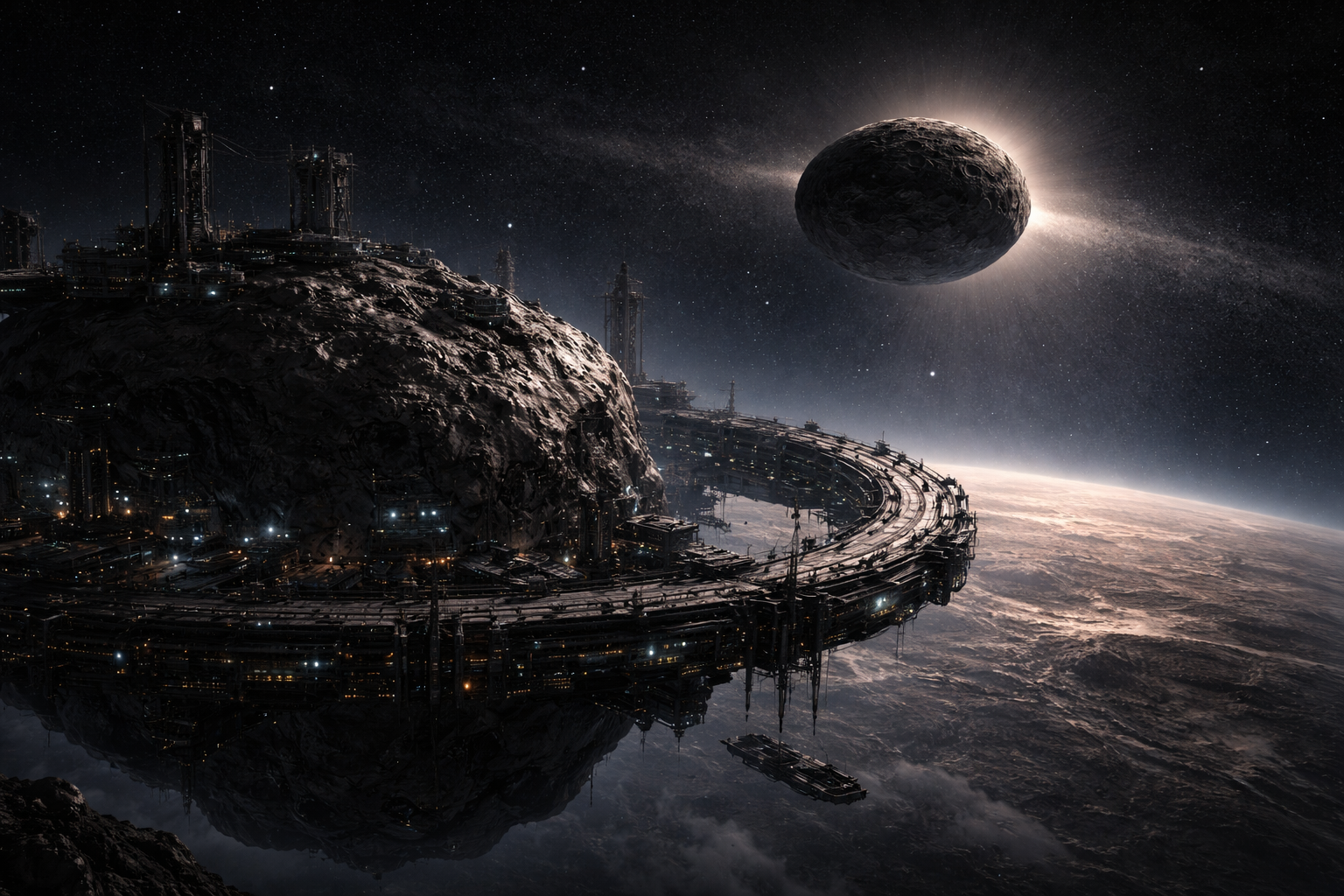
The Moons of Hypnoth
Shepherd, the Far Moon, Tertius, and the Arc
If Hypnoth is a world of recoverable structure, then its sky is a record of what structure costs.
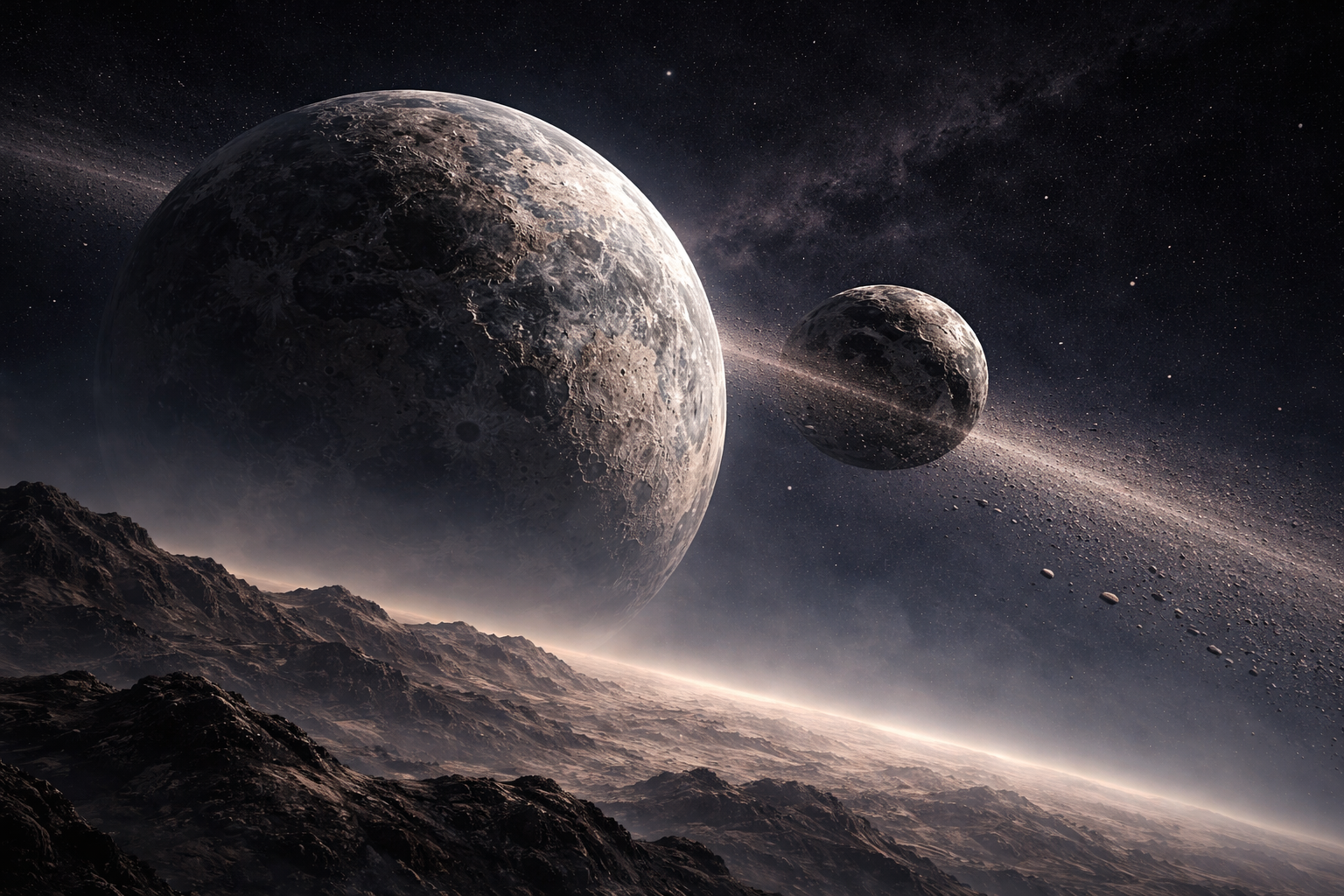
The planet does not turn beneath an empty heaven. It moves under company: one near moon that governs timing and light, one outer moon that gives the system distance and patience, and the long pale wound of a third moon that no longer exists except as aftermath. The archive fixes that architecture with unusual precision. Shepherd, the inner moon, circles Hypnoth at 60,000 km every 32.1 hours. The outer moon, listed simply as Moon II – Irregular, circles at 250,000 km every 11.4 days. A third moon, Hypnoth Tertius, once orbited at 95,200 km in a 2:1 resonance with Shepherd, before catastrophic tidal shredding reduced it to the shepherded debris ring now known as the Arc.
That matters because the sky above Hypnoth is not merely beautiful. It is mechanical, historical, and useful. Vôrun-Hold does not look upward for myth first. It looks upward for timing, shadow, drift, and the shape of conditions. Hypnoth’s moons are not ornaments. They are part of the world’s working truth.
Shepherd
The blade moon
Shepherd is the nearest and most intimate of Hypnoth’s surviving moons: a small inner satellite with a radius of 110 km, a mass of roughly 2×10¹⁹ kg, and an orbit close enough to dominate the planet’s immediate sky-life. At 60,000 km, it is not so close as to become oppressive, but it is far too near to become background. Its motion can be felt by anyone who lives under open sky long enough to notice the heavens as part of labor.
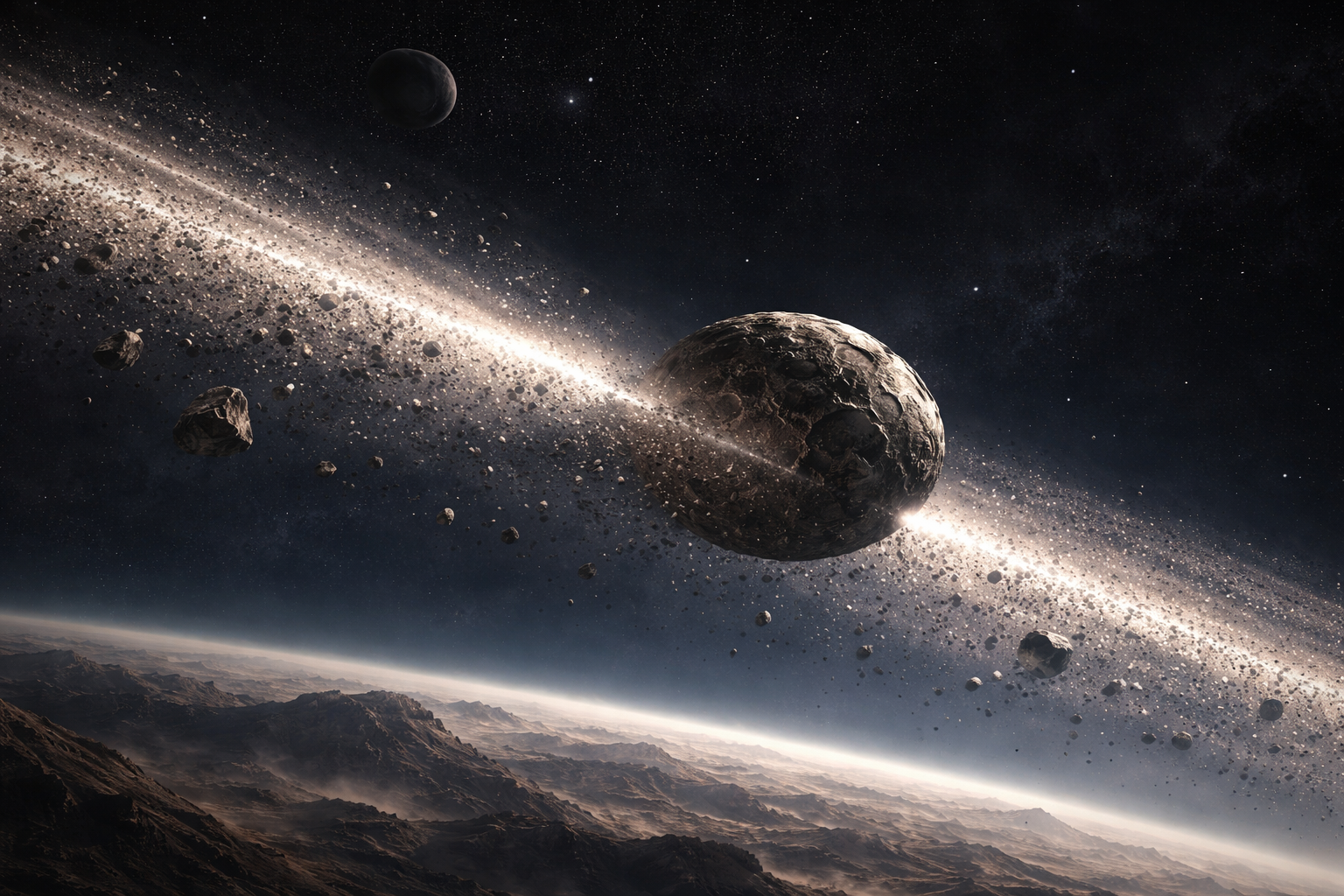
From the surface of Hypnoth, Shepherd does not feel remote in the way a far moon feels remote. It moves too decisively for that. When it passes beneath or through the line of the Arc, it appears almost surgical: a hard stone shape cutting a field of pale debris like a blade drawn through filings. That is the right image for it. Shepherd is not pastoral. It is precise.
Its physical character should follow from its scale. Shepherd is best imagined as a scarred stony-iron moonlet, compact and battered, with bright metal-tinged scarps, dark regolith stretches, old impact wounds, and hard exposed faces where earlier collisions stripped it back to tougher material. It is too small to read as a lush spherical world. It should look like a survivor.
What makes Shepherd indispensable is not only what it is, but what it does.
The archive ties it directly to one of the system’s defining operational events: Shepherd’s Cut. From the orbital perspective relevant to Vôrun-Hold, Shepherd can transit the primary star with an apparent size large enough to reduce starlight by around 70% for roughly 4 minutes, an event occurring two to four times per Hypnoth year. That is extraordinary not because it is mystical, but because it is measurable. Shepherd changes light, timing, and working conditions in ways the Hold must reckon with.
That is the heart of Shepherd’s identity. It is not simply the near moon. It is the moon of timing, of close sky, of altered light, and of continuity after damage.
The Far Moon
The distant witness
The outer survivor of Hypnoth’s broken lunar family is far less immediate and therefore, in its own way, more haunting. The archive leaves it almost starkly named — Moon II – Irregular — and that restraint suits the world perfectly. It circles at 250,000 km, takes 11.4 days to complete an orbit, and carries a mass of about 6×10²⁰ kg.
Where Shepherd feels close, sharp, and operational, the Far Moon feels remote, slow, and patient.
From the surface of Hypnoth it is not the moon a crew measures its shift against. It does not race the sky or alter the light of a single work window the way Shepherd can. It lingers. Its motion belongs to longer reckoning: convoy cycles, route assumptions, outer salvage timing, and the broader emotional sense that Hypnoth exists inside a larger surviving architecture than the immediate sky above one worksite.
That distance gives it a different authority. Shepherd is watched like a moving tool. The Far Moon is watched like weather, interval, or verdict.
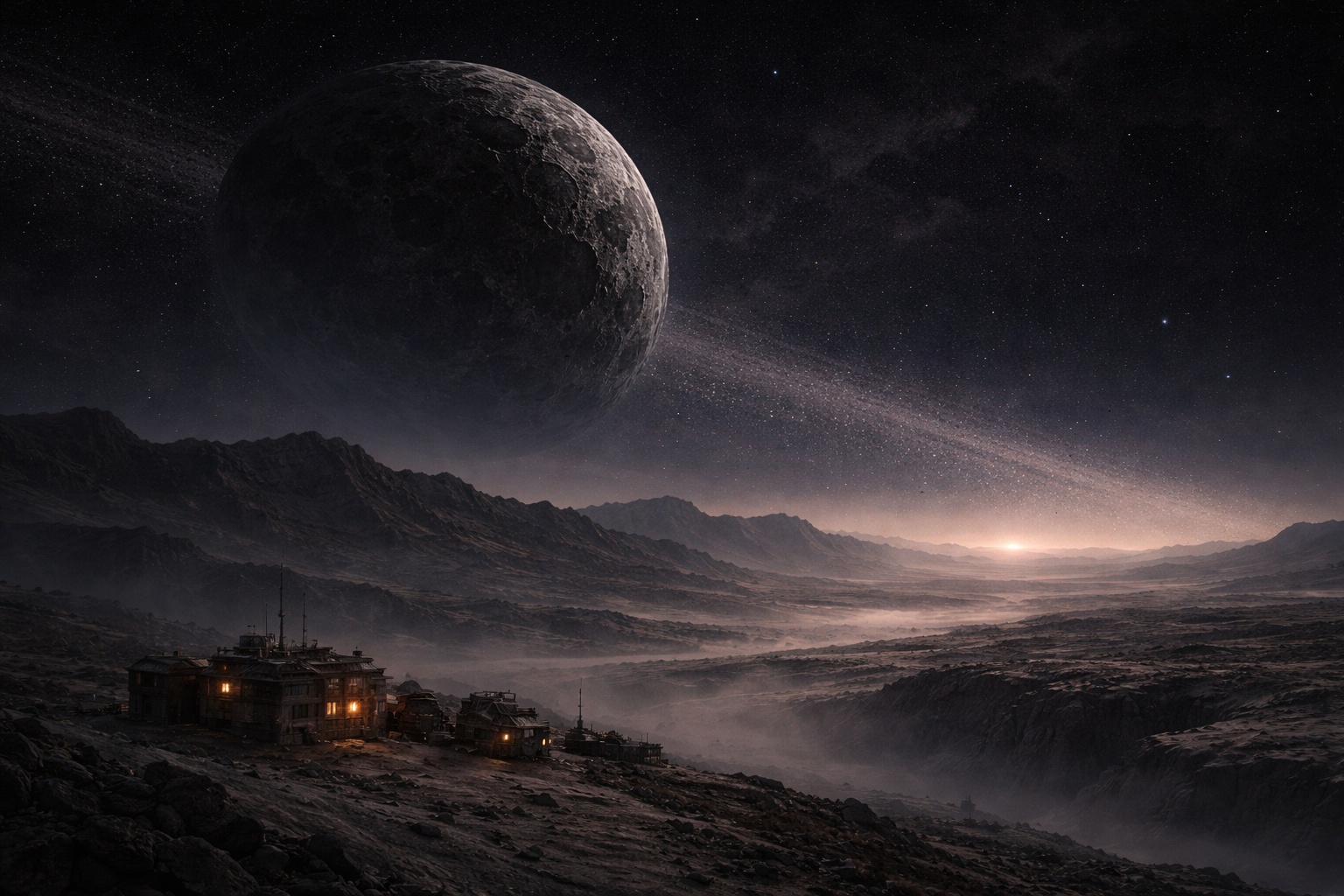
Physically, it should be imagined as a dark irregular survivor: asymmetrical, impact-scarred, broad-faced, and light-hungry. It should not gleam the way Shepherd sometimes glints, nor scatter light the way the Arc does. Instead it should read as charcoal, iron-grey, or dust-black, perhaps broken by pale scarps or exposed bright wounds where ancient impacts stripped back the darkened crust. Seen through Hypnoth’s haze or over the conductive dust-fields of the Ash Dorsae, it should sometimes feel less like a luminous object than a dark weight suspended in the sky.
Narratively, the Far Moon gives the system depth. Shepherd governs moments. The Far Moon governs intervals. It is the outer body that remained in motion after the resonance broke and the inner sky was torn open.
Hypnoth Tertius
The lost moon
Tertius was the moon that made the wound.
Before the Arc existed, before Shepherd’s crossings carried the feeling they do now, the inner system held a third major body: Hypnoth Tertius, orbiting at 95,200 km with a period of 64.2 hours, explicitly in a 2:1 resonance with Shepherd. At a radius of 500 km and a mass of 1.68×10²¹ kg, it was vastly larger than Shepherd and large enough that its destruction permanently altered both the mechanics and the appearance of Hypnoth’s sky.
The archive gives the mechanism cleanly. Tertius’s eccentricity rose to 0.77, bringing its pericenter down to roughly 22,000 km, close to Hypnoth’s conservative Roche threshold. The archive also gives a rubble-body Roche estimate of 17,520 km and a fluid-body estimate near 22,000 km. Tertius crossed into catastrophe. Tidal shredding followed.
This is what gives Tertius its true place in the setting. It was not merely lost. It was unmade by the gravity of the world it orbited.
That is stronger than any simple explosion myth. Tertius died the hard way: strained, fractured, and drawn apart into a debris stream by the planet’s pull. The Arc is what remains of that destruction. Every pale band overhead, every debris-bright crossing, every shard-stream visible in the right light is part of the afterlife of Tertius.
Because the archive explicitly sets Tertius in a 2:1 resonance with Shepherd, its destruction was not merely the loss of a moon. It was the loss of an orbital conversation. Shepherd once answered Tertius mechanically. Their periods were linked. After the destruction, that relationship did not disappear cleanly. It persisted in damaged form as the Arc, still shepherded, still crossed by the surviving inner moon that once shared a measured order with the body now reduced to wreckage.
That is the hidden poetry of the system: the lost moon is gone, but not absent.
The Arc
The sky made into aftermath
The Arc is the surviving body of Tertius in altered form: a broken shepherded debris ring composed of the fraction of the moon that remained in orbit after tidal disruption. The archive estimates that only 0.1–1% of Tertius’s original mass survived as a persistent ring fraction, leaving the Arc with a retained mass on the order of 10¹⁸ to 10¹⁹ kg. Under shepherding, that debris can persist for 10⁷ to 10⁸ years.
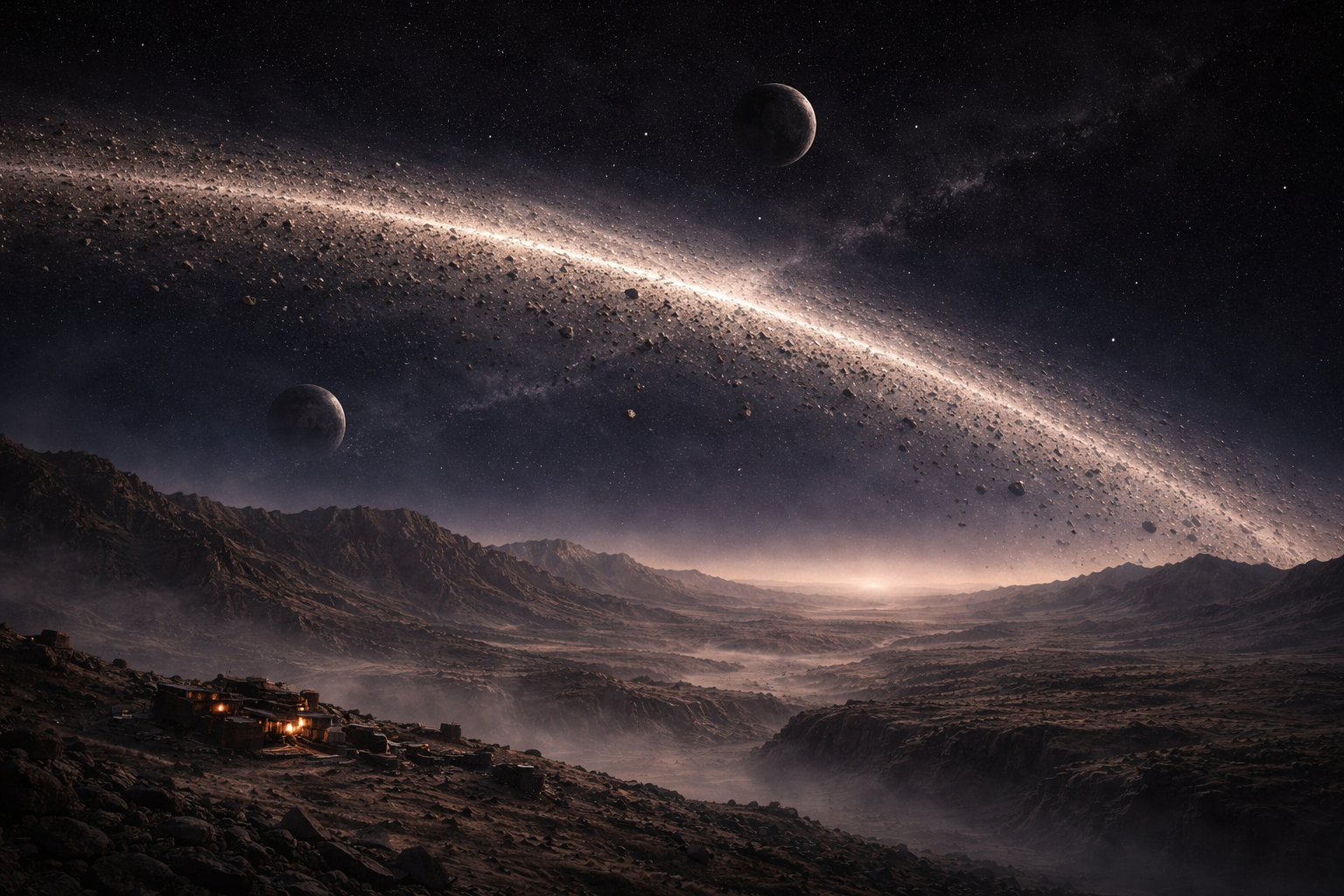
That is why the Arc should never be treated as a decorative ring in the Saturnine sense. It is too sparse, too violent in origin, and too loaded with implication. It is a broken ring, a pale wound across the heavens made of dust, metallic fines, grit, and larger shard-mass. In some skies it hangs like a narrow blade. In others it broadens into a belt of filings and pale debris. It is not uniform, and it should never feel uniform.
From the ground, the Arc is the most famous feature of Hypnoth’s sky and the easiest to misread. Outsiders would see beauty first. The Kin see utility first. The Arc changes nights. It alters light levels and contrast on broken ground. It shapes orientation and affects how open land reads under low illumination. It is part of the working environment.
That is what makes it so perfectly Vôrun. The Arc is not important because it is lost beauty. It is important because it is loss made structurally relevant.
Its best internal structure is not a smooth band but a layered one: the Dust Veil, where the finest particulate gives the Arc much of its soft glow; the Shard Stream, where denser and more dangerous debris dominates; the Widow Lanes, where gaps and underdense stretches prevent the ring from feeling too neat; and the darker Black Choir sectors, where low-albedo or otherwise unsettling debris lanes make the Arc feel less luminous and more withholding.
These are not merely aesthetic variations. They make the ring feel like a real wound — structured, uneven, and still mechanically alive.
Why the sky matters to Vôrun
The moons of Hypnoth are strongest when treated not as symbols first, but as conditions first.
Shepherd affects work windows and light.
The Far Moon affects interval and the sense of system depth.
Tertius explains why the sky is broken.
The Arc turns destruction into a continuing operational fact.
That is exactly the sort of celestial order Vôrun-Hold would respect. Not because it flatters myth, but because it shapes reality.
The Hold already lives by a culture of continuity, load, correction, and return. The lunar architecture of Hypnoth mirrors those values with eerie precision. Shepherd is continuity under altered conditions. The Far Moon is persistence without display. Tertius is structure broken by force. The Arc is return of a kind — not restoration, but survival as consequence.
In a softer setting, that might become romantic. On Hypnoth, it becomes practical.
Crews plan under Shepherd.
Route-houses reckon with the Far Moon.
Salvagers work under the Arc’s changing light.
And every Kin born beneath that sky learns, before they know the equations, that the heavens above their world are not innocent. They are remainder.