The Drone Carrier of Vôrun Hold
The Drone Carrier of Vôrun Hold
The Hold’s Swarm Command Vessel
Not every resource field in the Vidar system can be harvested through conventional means.
Some debris clusters are too dense for Salvage Cutters to dismantle safely.
Some asteroid formations contain mineral deposits buried deep within unstable rock.
Some wreckage fields contain valuable machine components embedded within twisted structures that would take years for crewed vessels to disassemble.
For these situations, Vôrun Hold deploys one of its rarest industrial vessels.
The Drone Carrier.
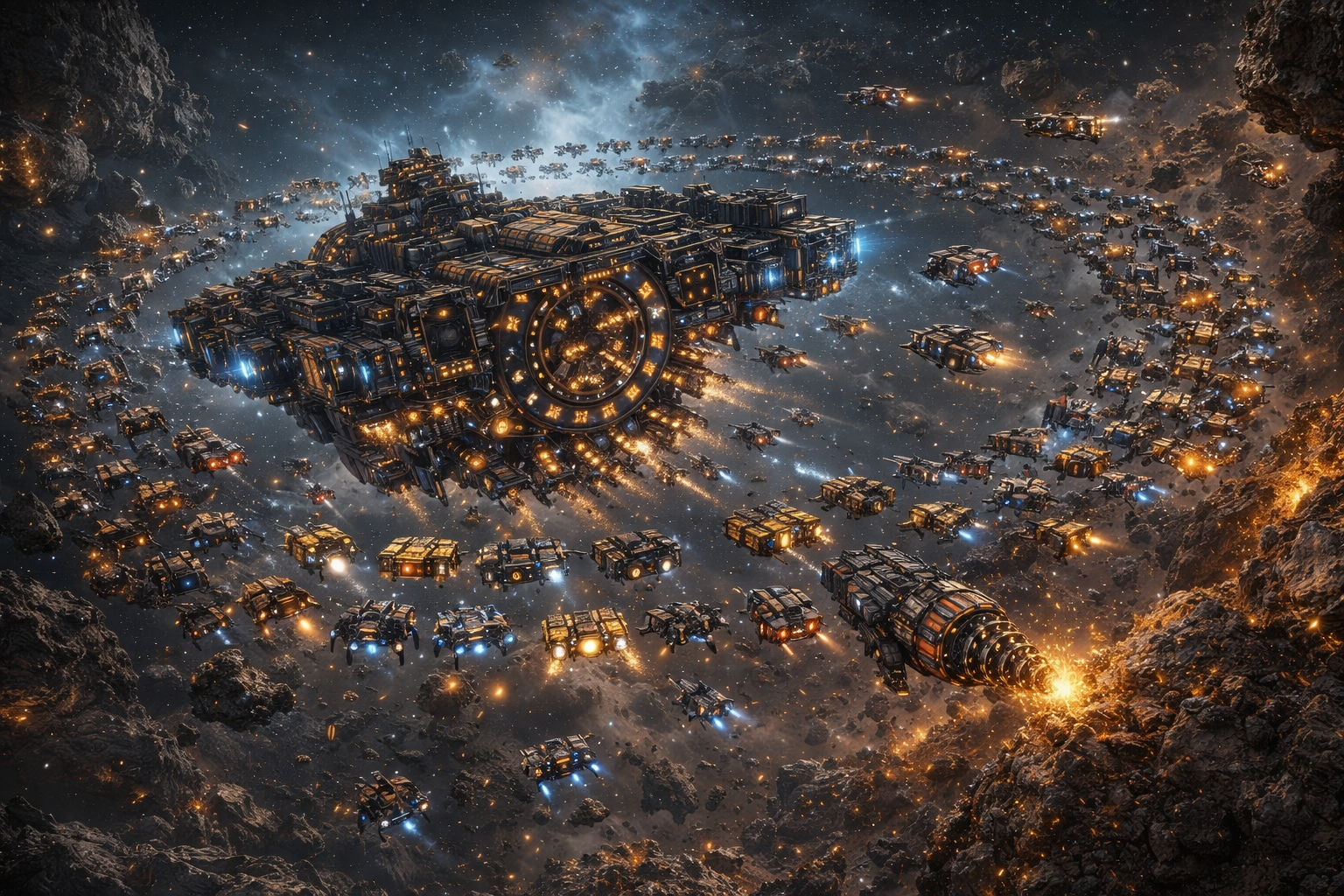
Rather than performing extraction directly, the carrier commands a swarm of autonomous industrial machines. Hundreds of drones operate simultaneously across wide regions of space, dismantling structures, extracting rare ore, and transporting material back to the carrier.
Where other ships of the Hold work with tools, the Drone Carrier commands an industrial ecosystem of machines.
It does not replace the rest of the fleet.
It multiplies their effectiveness.
Physical Specifications
Vessel Classification: Industrial Drone Carrier
Hold Designation: Vôrun Pattern – Iteration II
Length: 168 meters
Width: 96 meters
Height: 52 meters
Empty Mass: 46,000 tonnes
Drone Complement:
320 active drones
80 reserve drones
Deep Core Extraction Drones:
2–3 units
Crew: 22 Kin
The Drone Carrier is smaller than the massive Industrial Haulers of the fleet but far more complex internally. Large portions of the vessel’s structure are dedicated to drone racks, swarm coordination systems, and precision industrial processing equipment.
The Purpose of the Drone Carrier
The Drone Carrier exists to solve extraction problems that conventional ships cannot.
Its deployments generally occur under two circumstances.
Dense Debris Fields
Some asteroid clusters or wreckage zones contain valuable materials scattered across complex structures.
Rather than sending multiple ships to work the field piece by piece, the Hold deploys a single Drone Carrier.
The vessel then releases its swarm.
Hundreds of machines dismantle the field simultaneously.
Precision Rare Ore Extraction
Certain deposits contain extremely valuable ores embedded deep within unstable rock or wreckage.
These materials must be recovered carefully.
The Drone Carrier’s swarm is capable of isolating these deposits without destroying them.
This type of operation may last weeks or even months.
The carrier remains on station while the swarm performs the work.
The Drone Hive
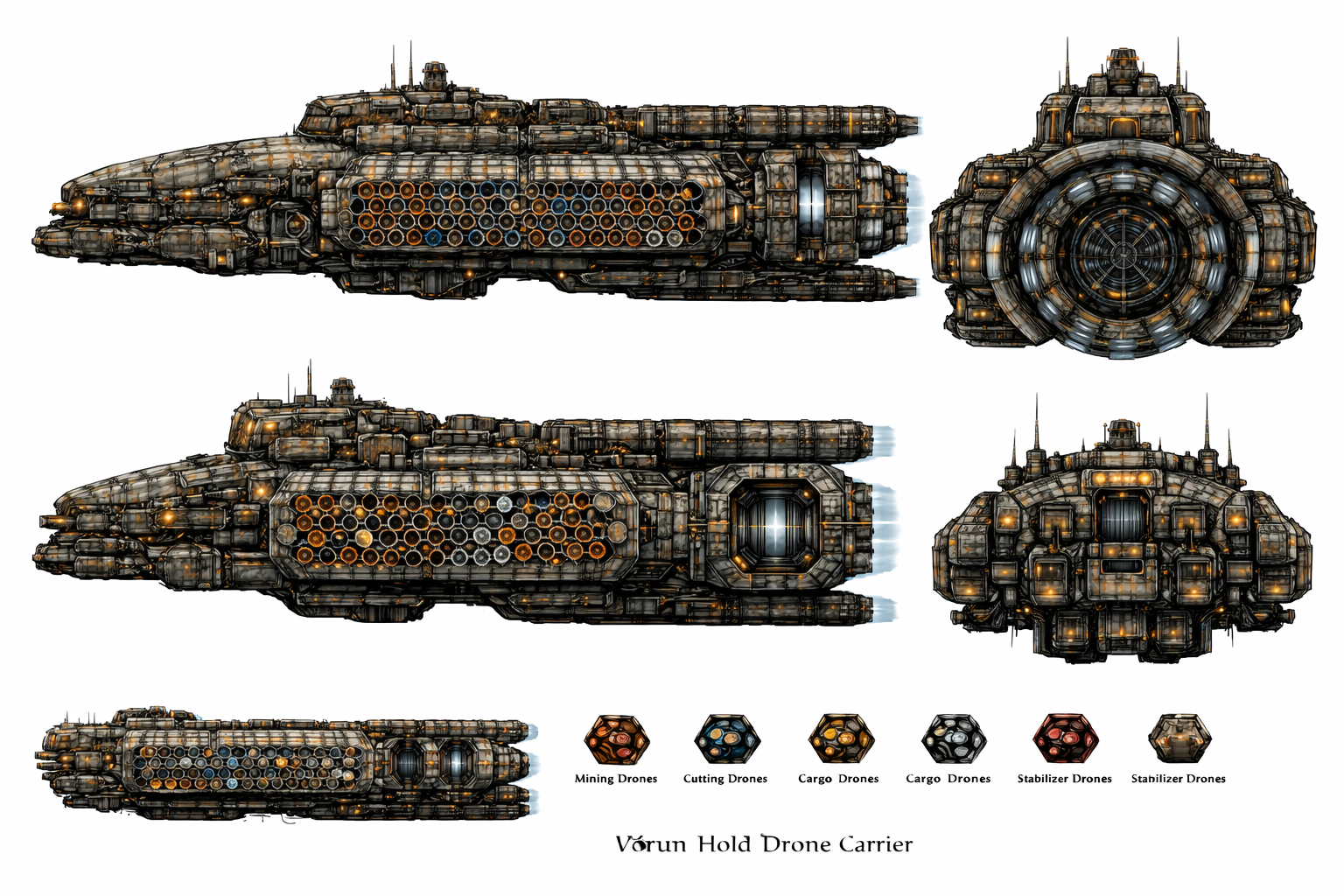
The defining feature of the Drone Carrier is its honeycomb drone rack system.
Across the midsection of the vessel are hundreds of tightly packed hexagonal rack cells.
Each cell houses a single drone.
The racks form a visible mechanical hive across the hull.
Every rack contains:
• mechanical docking clamps
• power recharge feeds
• data uplinks
• diagnostic ports
• quick repair systems
Drones dock directly into the racks using reinforced docking collars that lock into mechanical clamps.
This system allows hundreds of drones to launch or return simultaneously without congestion.
During operations the racks glow with amber industrial lighting, giving the ship the appearance of a vast mechanical hive.
The Drone Swarm
The Drone Carrier commands a swarm of 320 industrial drones, supported by 80 reserve units stored within the vessel.
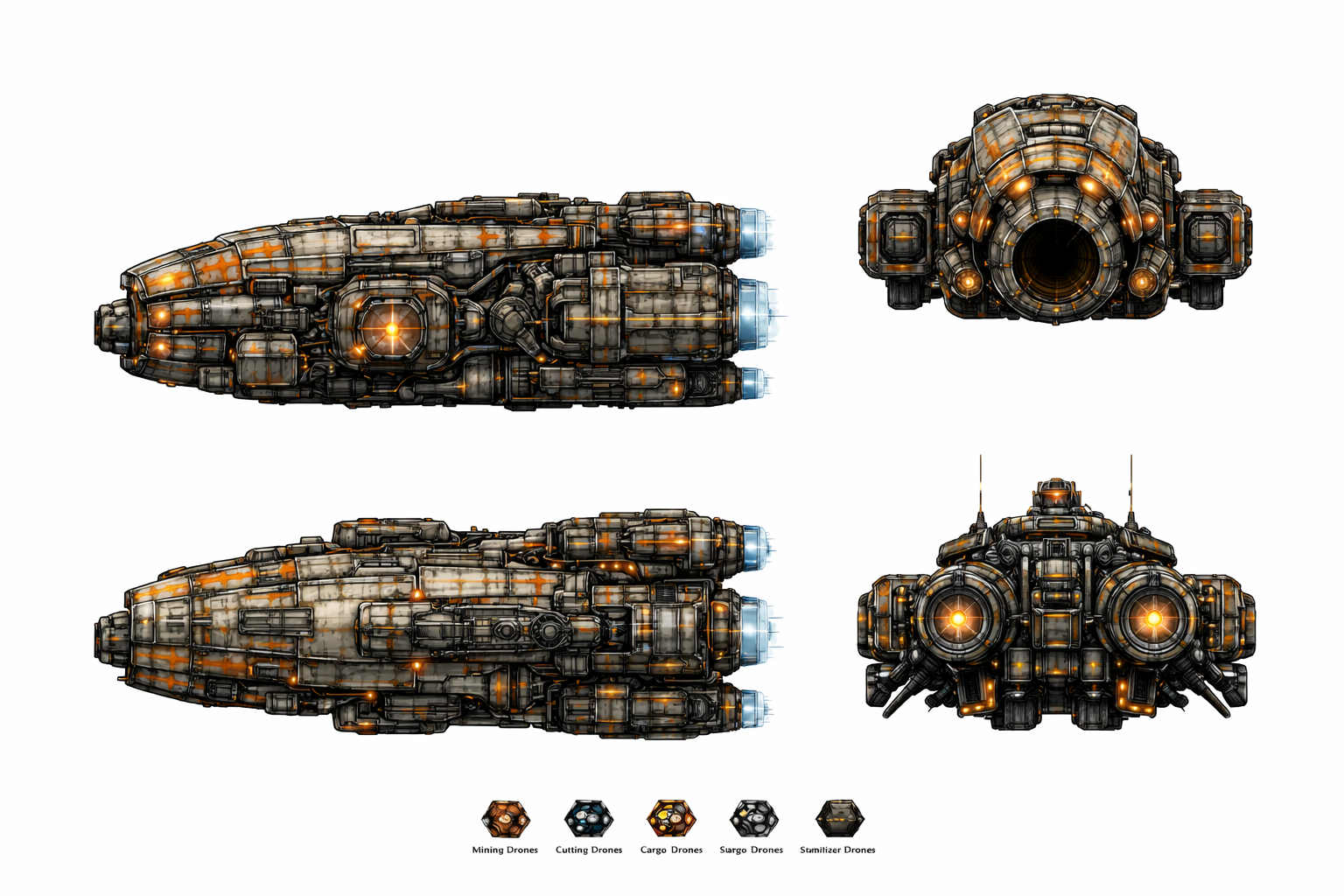
These machines are compact and durable, designed as rugged industrial tools rather than miniature spacecraft.
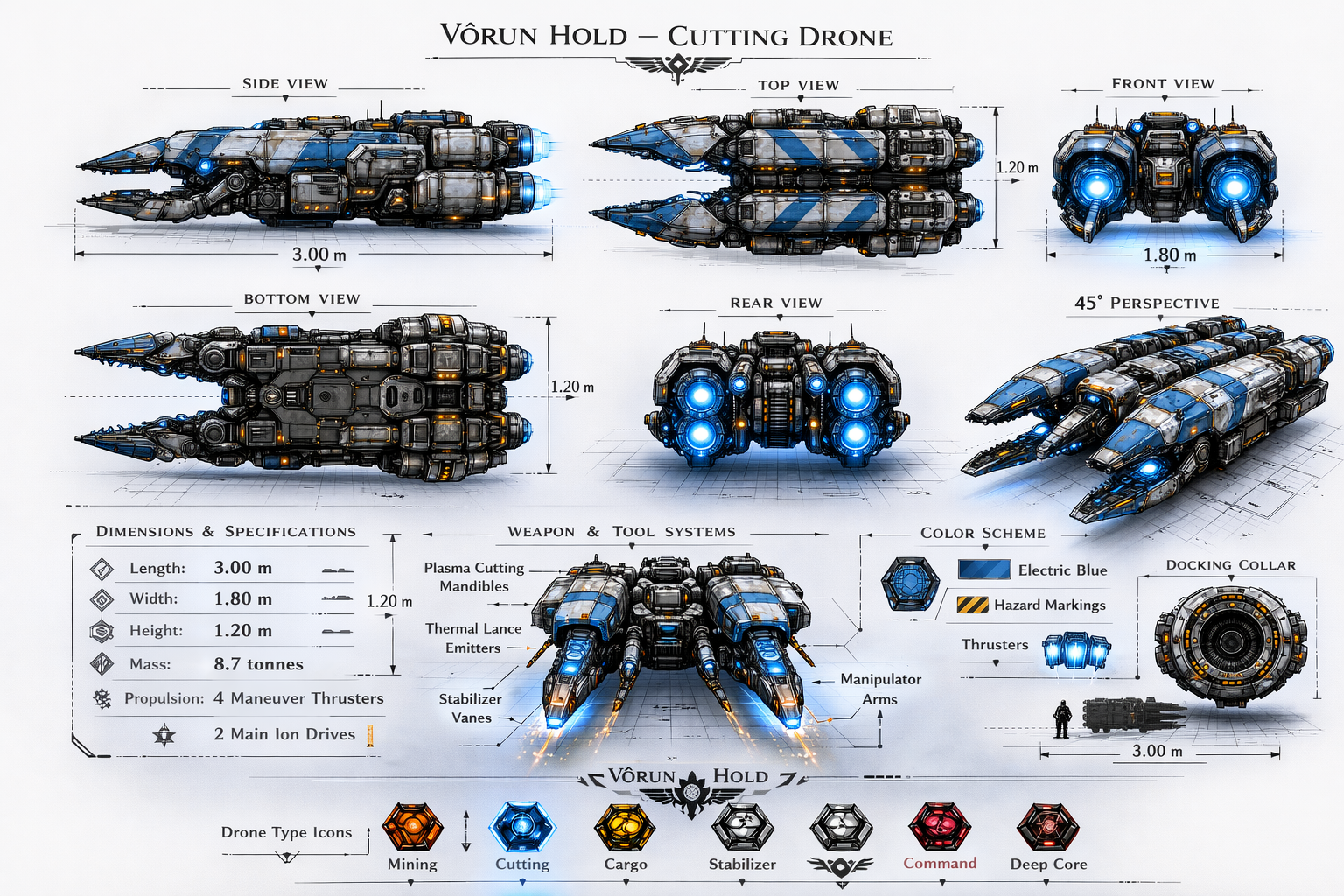
Typical drone length is approximately three meters.
Each drone resembles an armored industrial pod equipped with integrated tools.
Their hulls are reinforced to withstand debris impacts and the stresses of constant industrial work.
Propulsion is provided by compact maneuvering thrusters combined with directional thrust vanes, allowing the drones to maintain stable positioning while drilling or cutting.
Unlike many mining machines, these drones do not land on surfaces.
Instead they hover in place while performing their tasks.
Drone Types
Although they share a common chassis design, the swarm contains several specialized drone classes.
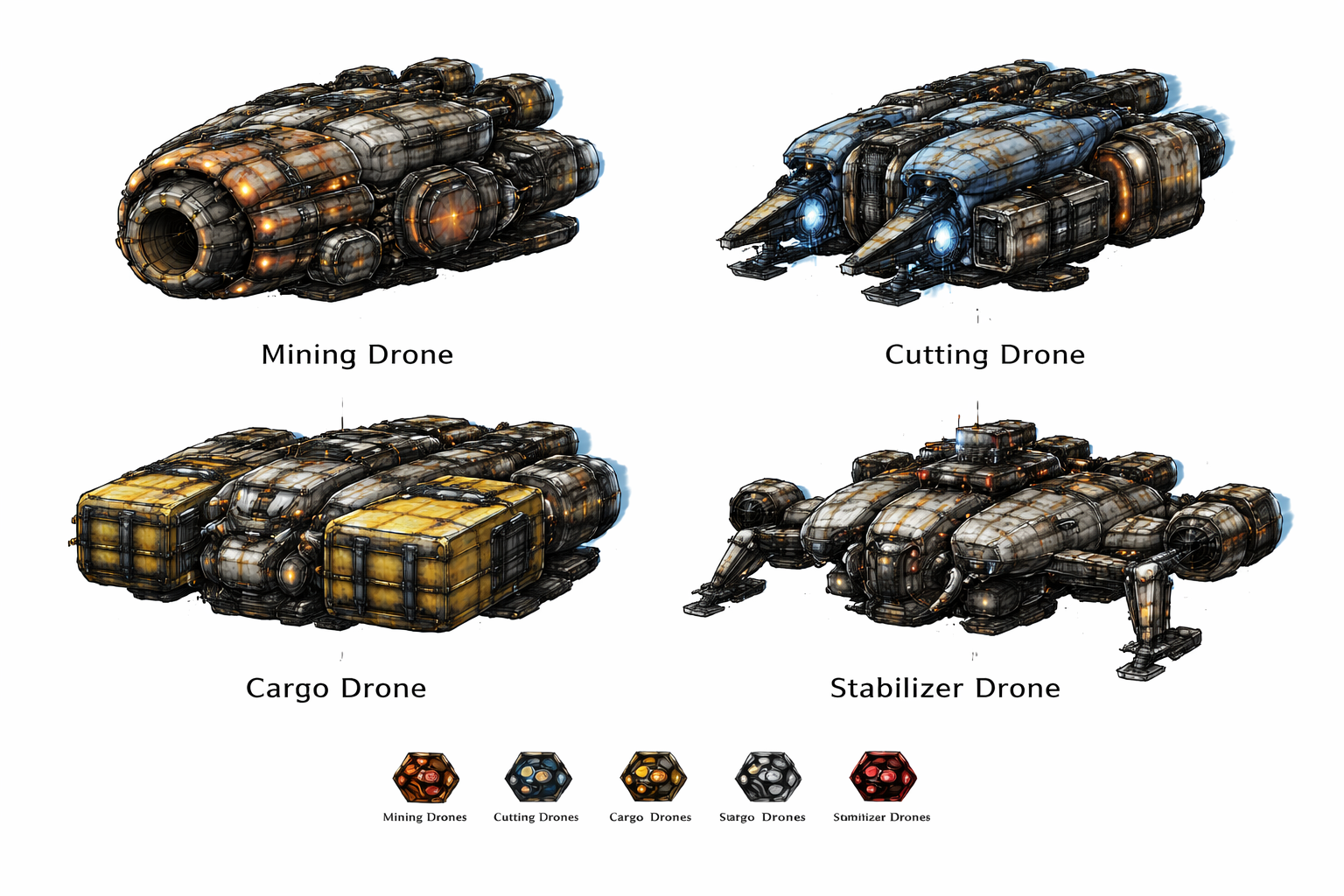
Mining Drones
Mining drones perform the majority of extraction work.
They carry rotary drilling assemblies and fracture pulse emitters designed to expose mineral veins buried within rock or debris.
Rather than removing large quantities of material, mining drones focus on isolating valuable deposits for recovery.
Color marking: Burnt orange
Visual identifier: Forward drill cone
Cutting Drones
Cutting drones dismantle wreckage structures and industrial debris.
Equipped with plasma cutters and thermal lances, they are capable of slicing through reinforced hull materials and internal support frameworks.
They are particularly useful when dismantling the dense architecture of Imperial vessels.
Color marking: Electric blue
Visual identifier: Wide forward cutting mandibles
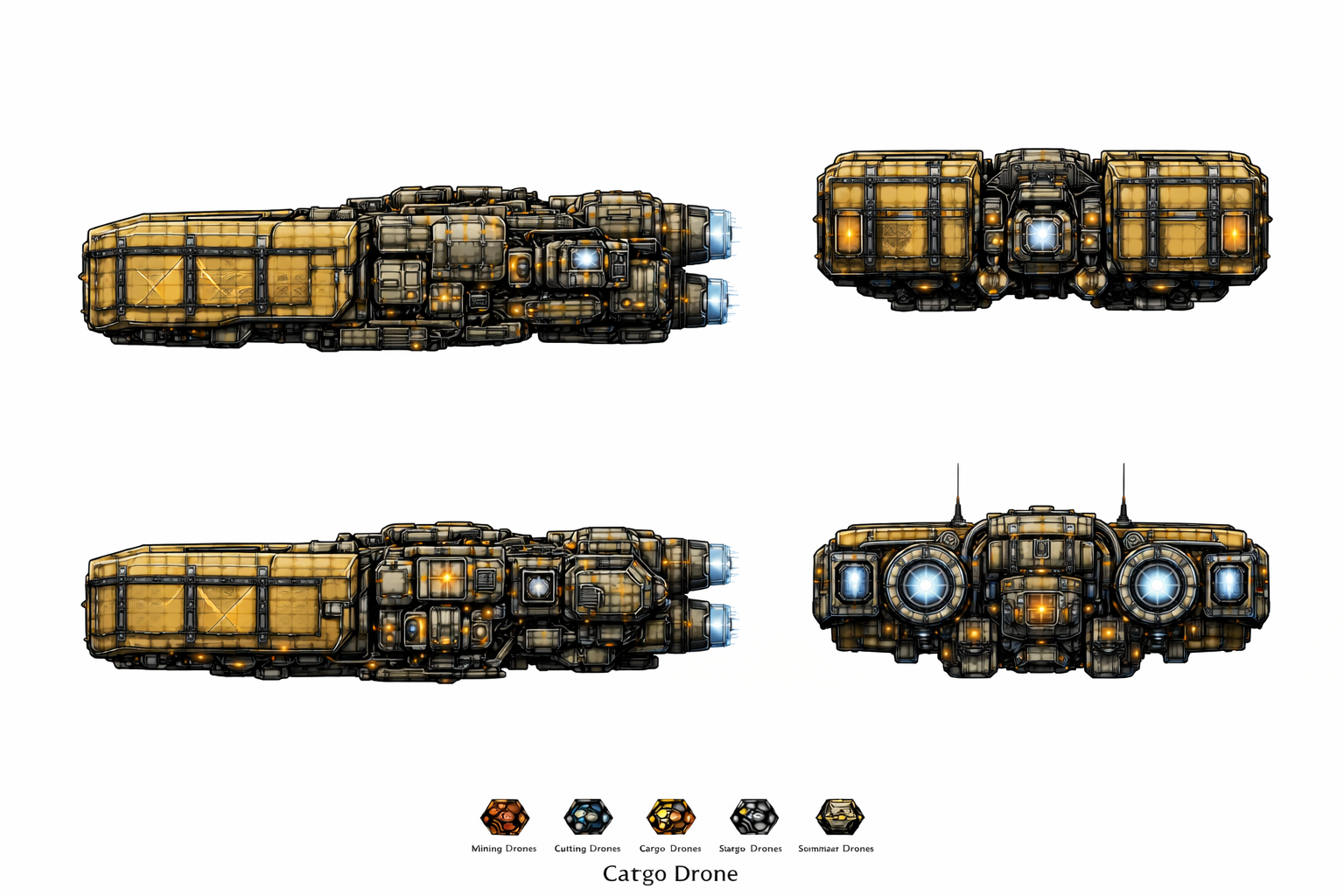
Cargo Drones
Cargo drones transport extracted materials back to the Drone Carrier.
These drones are slightly larger than the other swarm units and carry reinforced cargo compartments.
During major operations cargo drones move in continuous transport loops between the swarm and the carrier.
Color marking: Industrial yellow
Visual identifier: Box-shaped cargo module
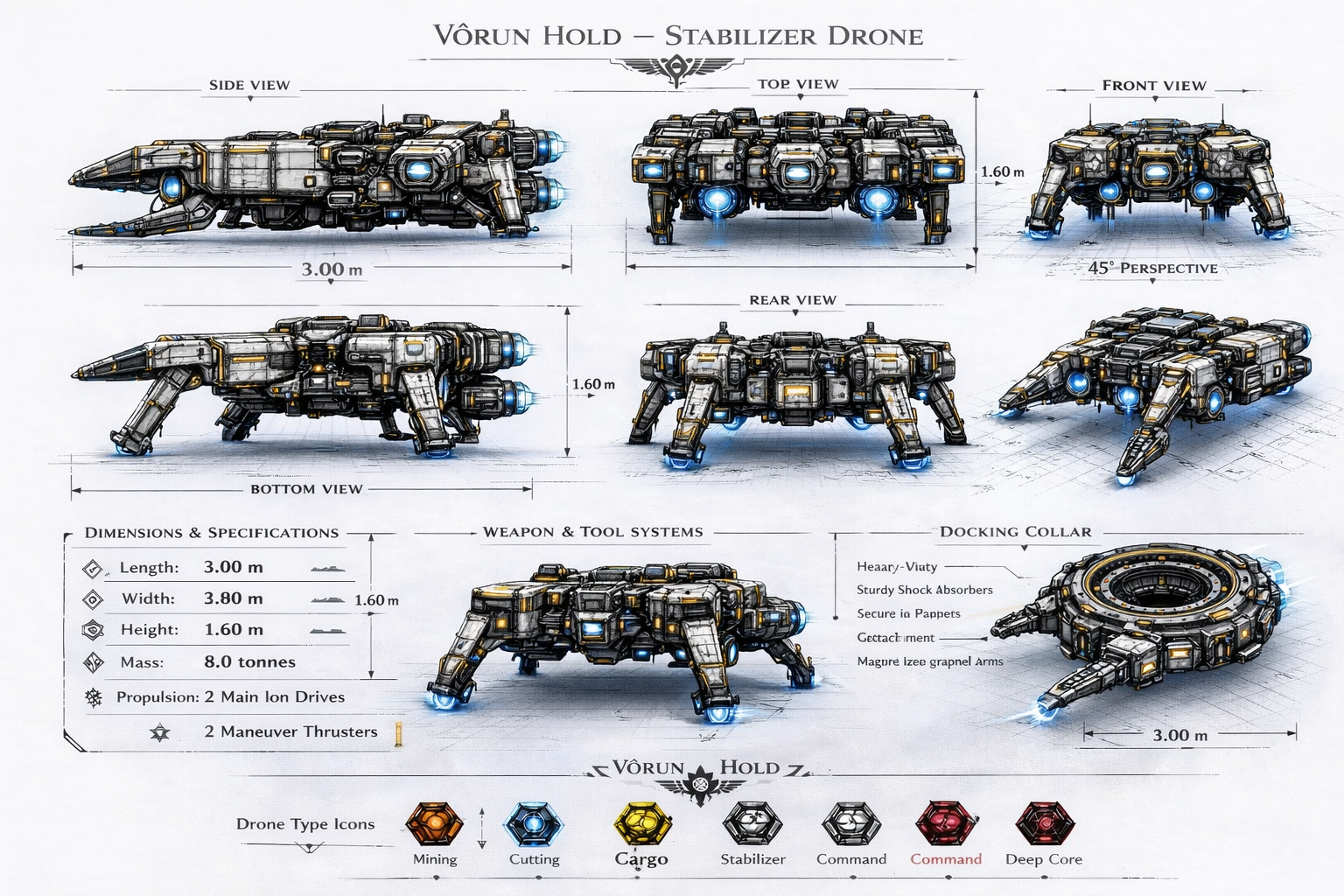
Stabilizer Drones
Some debris structures are too unstable to dismantle safely.
Stabilizer drones deploy gravitic anchors and structural analysis systems that secure large debris sections during extraction.
Without these machines valuable materials could be lost in uncontrolled fragmentation.
Color marking: White with black hazard bands
Visual identifier: Multiple anchor emitters beneath the hull
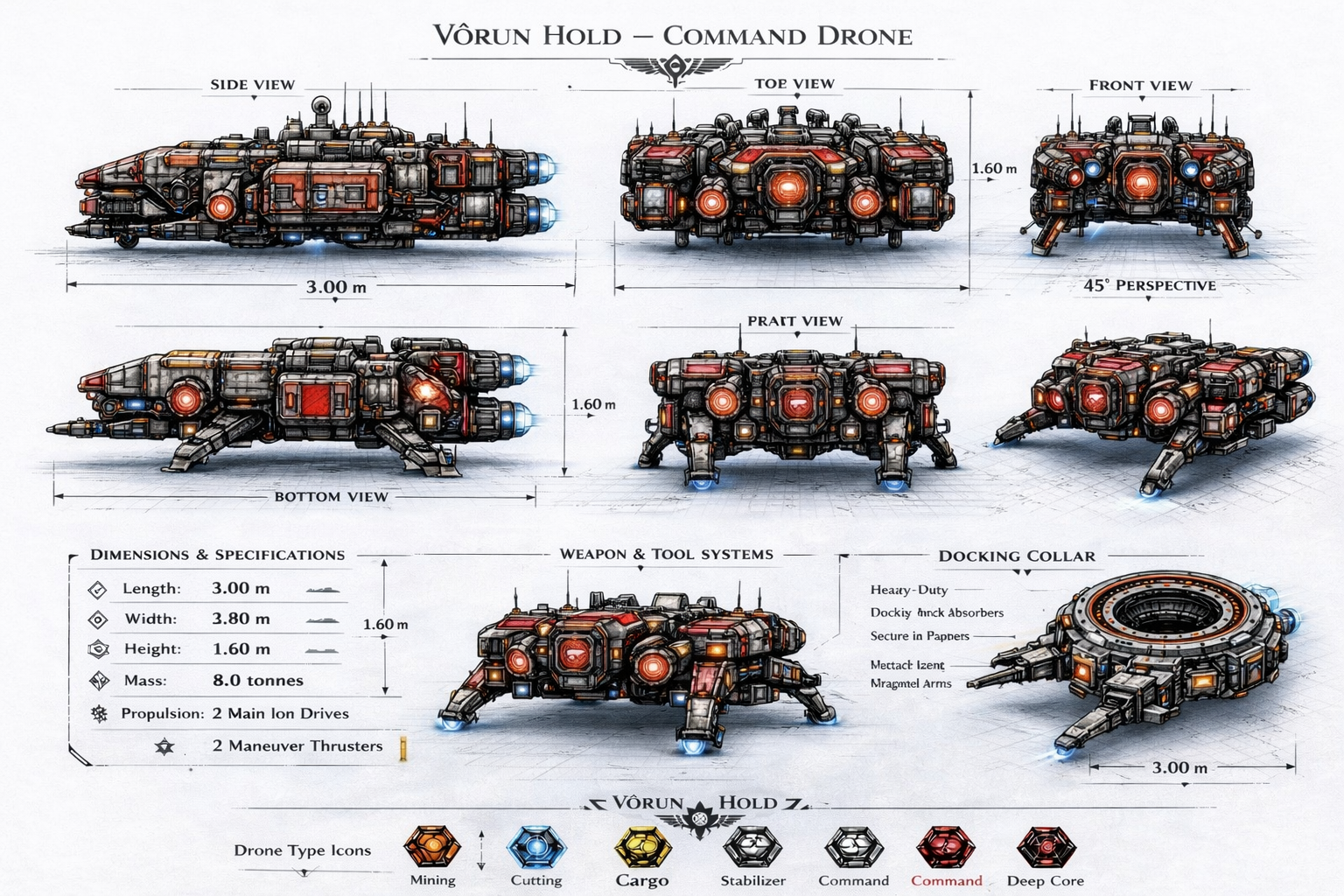
Command Drones
A small number of command drones operate within the swarm.
Unlike the other units, these drones contain Ironkin logic cores.
Command drones function as mobile coordination nodes that monitor swarm activity and continuously optimize extraction operations.
They relay data between the swarm and the Drone Carrier while directing drones to where they are most effective.
Color marking: Deep crimson
Visual identifier: expanded sensor arrays and communication antennae
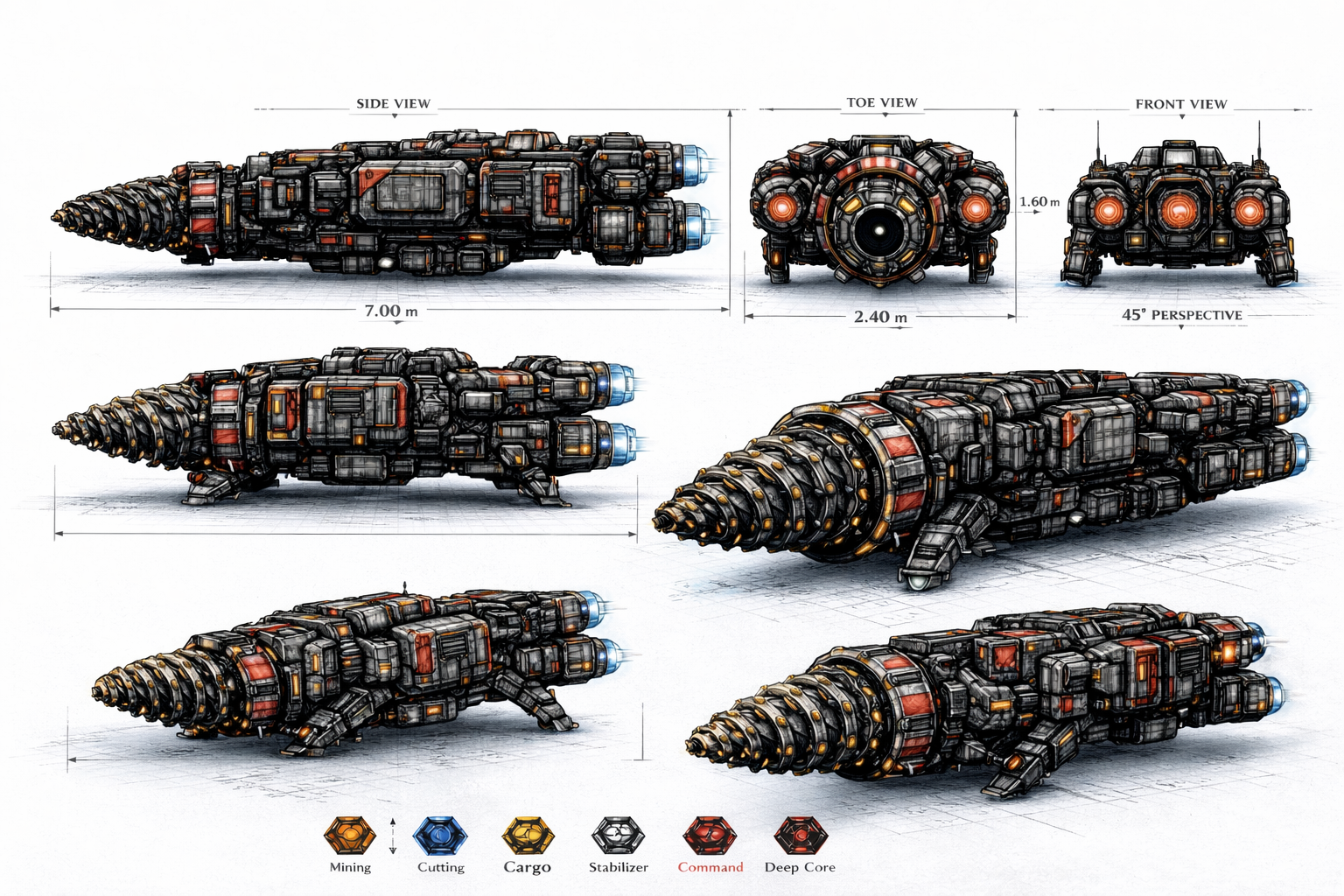
The Deep Core Extraction Drone
Occasionally the swarm encounters a resource deposit that cannot be recovered using standard drones.
These deposits may lie buried deep within dense asteroid rock, sealed inside massive wreckage structures, or surrounded by unstable material that would collapse if disturbed.
For these situations the Drone Carrier deploys a specialized machine.
The Deep Core Extraction Drone.
Physical Characteristics
Deep Core drones are significantly larger than standard swarm units.
Length: approximately 7 meters
The drone’s hull is heavily reinforced and built around a powerful drilling assembly that dominates the forward section of the machine.
While smaller drones resemble compact industrial pods, the Deep Core drone appears more like a mobile drilling platform.
Color marking: dark iron plating with crimson hazard striping
Extraction Systems
The Deep Core drone carries a powerful Deep Penetration Drill Assembly.
This system combines several industrial technologies.
Rotary Core Drill
A reinforced drilling system capable of penetrating dense rock or heavily armored wreckage.
Fracture Pulse Emitters
Gravitic emitters weaken surrounding material, allowing the drill to advance while minimizing structural collapse.
Precision Core Extractor
Once the drill reaches the target deposit, a specialized extractor isolates the valuable material intact.
This allows the recovery of:
• rare mineral cores
• archeotech fragments
• Standard Template Vault components
• exotic alloys
Swarm Integration
When a Deep Core drone is deployed, the rest of the swarm reorganizes to support the operation.
Mining drones clear surrounding rock.
Cutting drones dismantle structural obstacles.
Stabilizer drones secure the environment.
Cargo drones prepare to transport the recovered material.
Command drones coordinate the entire operation.
The Deep Core drone then begins the final extraction.
Swarm Intelligence
The drone swarm operates using distributed swarm logic systems.
Rather than issuing commands to individual machines, the Drone Carrier assigns operational objectives.
Drones organize themselves into cooperative task groups.
Mining drones expose ore deposits.
Cutting drones dismantle surrounding structures.
Stabilizer drones secure unstable debris.
Cargo drones transport material.
Command drones continuously analyze the system and optimize the swarm’s behavior.
From a distance the swarm appears as a constantly shifting cloud of machines spreading across the resource field.
Deployment
When the Drone Carrier begins an operation, the honeycomb racks across the hull unlock simultaneously.
Hundreds of drones detach in seconds.
For a moment they hover around the ship.
Then the swarm spreads outward across the asteroid field.
Within minutes the machines may cover kilometers of space.
Industrial Processing Systems
The Drone Carrier contains limited industrial processing systems.
Rather than refining bulk material, the ship focuses on concentrating high-value resources.
Its systems include:
• ore grinding arrays
• rare metal separation chambers
• contamination filtering systems
• precision micro-refining equipment
Low-value rock is discarded.
Only valuable materials are retained.
Maintenance Systems
Drone repairs occur through a hybrid system.
External Quick Repair Stations
Minor damage is repaired directly at the drone racks.
Automated tools perform diagnostics, hull patching, and tool replacement.
Internal Repair Gantry
Heavily damaged drones are transferred to an internal repair gantry where mechanists and fabrication systems perform extensive repairs.
Reserve drones replace damaged units during long operations.
Drive Carousel
The propulsion system of the Drone Carrier is built around a rotating drive carousel.
Multiple engines are mounted within a circular structural frame at the rear of the vessel.
The carousel rotates continuously during operation.
This configuration stabilizes the ship as drones dock and depart while allowing precise maneuvering within dense debris fields.
Defense
Drone Carriers are not designed for direct combat.
However they remain valuable assets.
Typical defensive systems include:
• point defense turrets
• interceptor missiles
• electronic countermeasures
Most deployments are protected by escort vessels from the Hold’s defensive fleets.
Crew
Despite its complexity the Drone Carrier operates with only 22 Kin crew members.
Typical roles include:
Voidmaster – vessel command
Drone Fleet Coordinator – swarm control
Mining Operations Supervisor
Salvage Operations Supervisor
Drone Mechanics
Navigation Officers
Engineering Crew
Ironkin Control Node
The drones perform the labor.
The Kin ensure the system functions perfectly.
The Awakening of the Hive
When the Drone Carrier enters a new resource field, the ship remains motionless at the center of the operation.
Across its hull the honeycomb racks unlock.
Hundreds of drones detach in seconds.
For a moment they hover around the vessel like a cloud of metallic insects.
Then the swarm spreads outward into the asteroid field.
The machines begin their work.
And the Hold reshapes the debris of the galaxy.