The Survey Cutter of Vôrun Hold

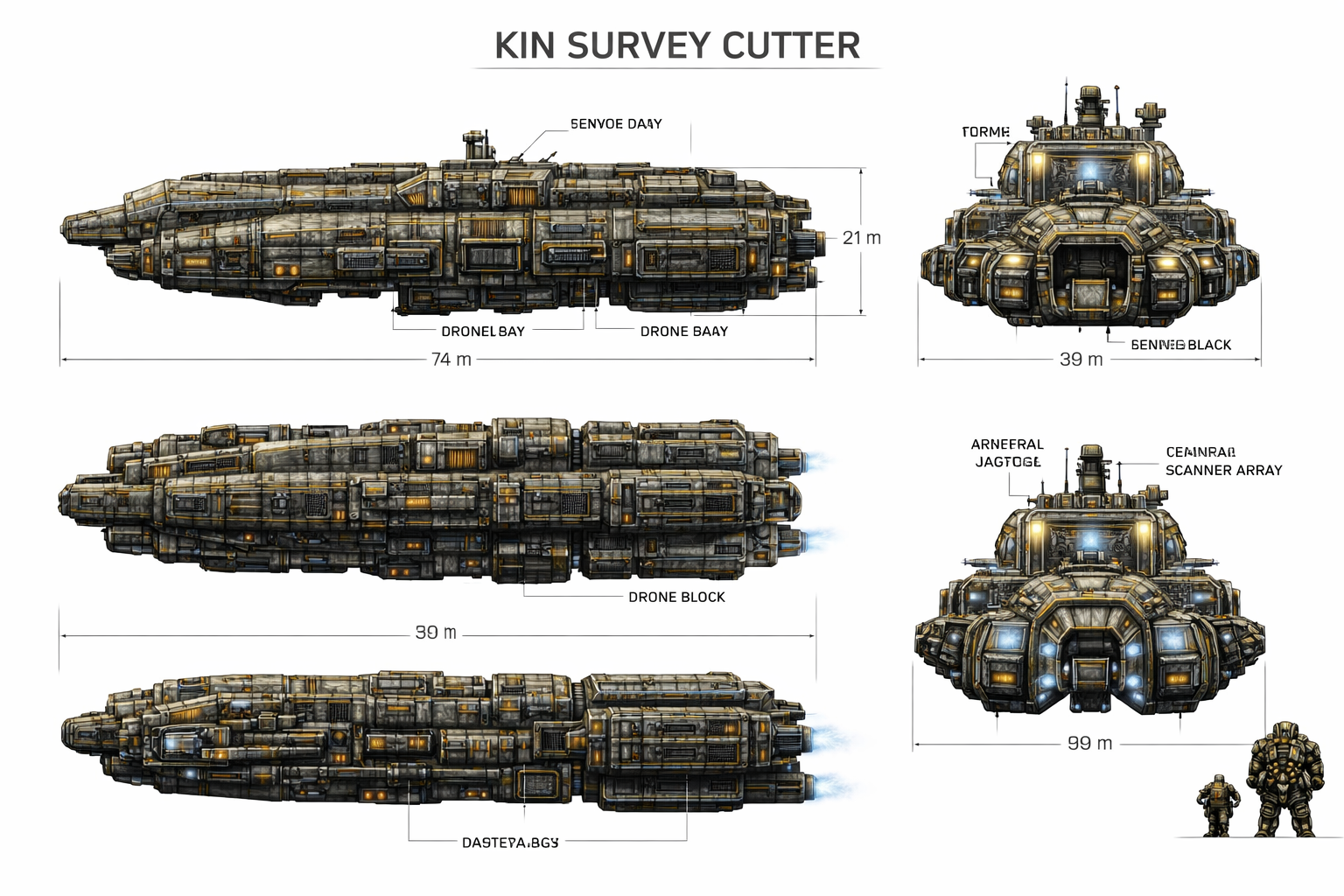
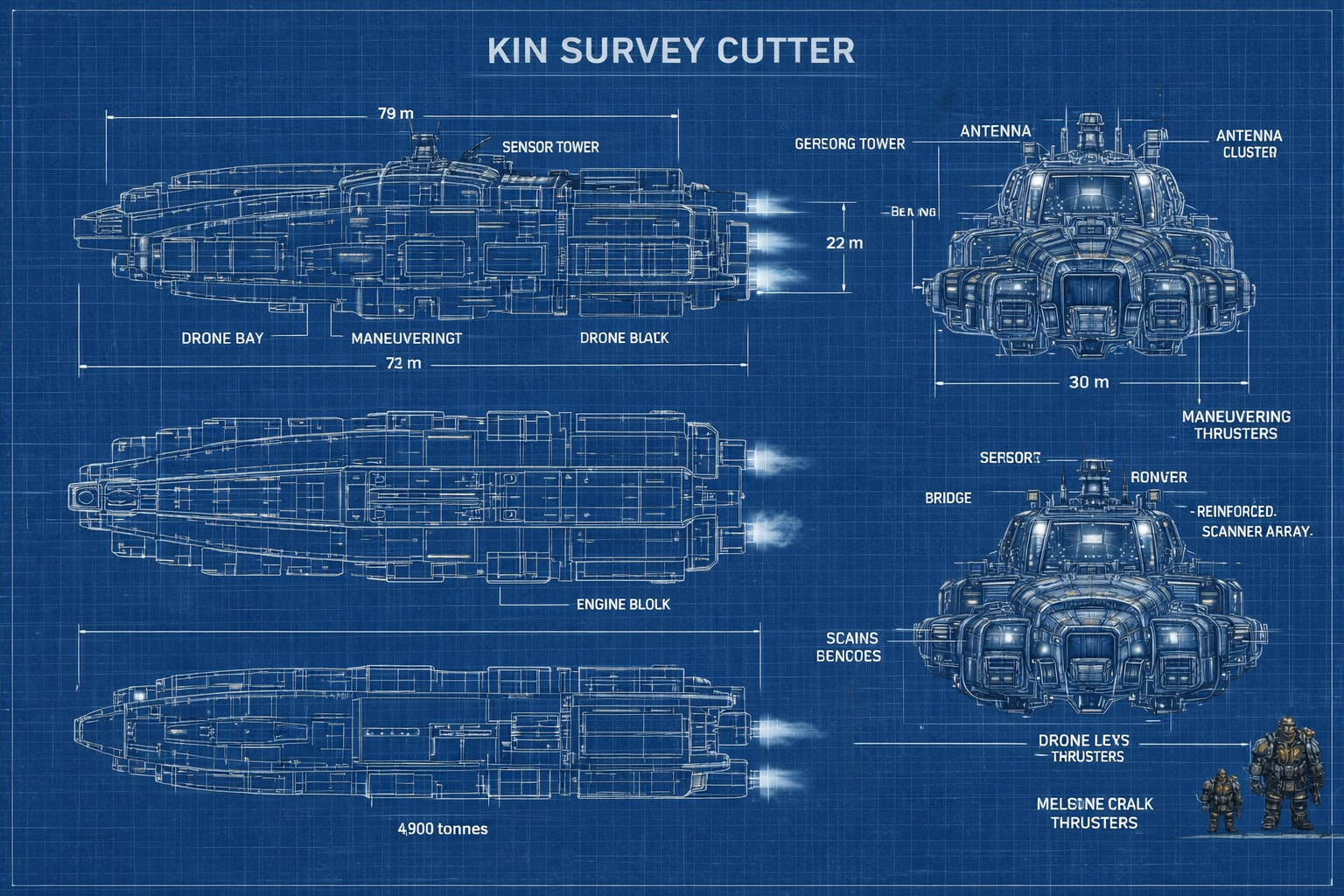
The Survey Cutter of Vôrun Hold
The Eyes of the Hold
Before anything can be mined, salvaged, or transported, it must first be discovered.
The Kin of Vôrun Hold understand this principle better than most void-faring civilizations. Resources in the Vidar system are not evenly distributed. Asteroid clusters shift, debris fields evolve, and long-forgotten wrecks drift across centuries of orbital decay.
Without accurate mapping, opportunity is lost.
The Survey Cutter exists to ensure that nothing of value escapes the attention of the Hold.
These vessels operate far beyond the immediate territory of Vôrun Hold, patiently scanning the asteroid belts, debris fields, and outer system regions of the Vidar system.
They are not built to carry cargo.
They are built to see.
Their discoveries become the foundation upon which every Salvage Cutter mission and every Industrial Hauler shipment depends.
Purpose
The Survey Cutter is the reconnaissance and discovery vessel of Vôrun Hold’s industrial fleet.
Its primary function is to map the Vidar system and identify locations suitable for resource extraction or salvage operations.
Targets typically include:
• metallic asteroid concentrations
• dormant shipwreck clusters
• mineral-rich planetary fragments
• deep mineral veins within large asteroids
• gravitational anomalies indicating hidden mass
• debris clouds from historical void battles
The Cutter does not extract resources itself.
Instead, it evaluates sites and determines whether the expected yield justifies deployment of larger industrial vessels.
This information allows the Hold to deploy Salvage Cutters and Industrial Haulers only when the return will justify the effort.
Efficiency is the objective.
Discovery without evaluation is useless.
Physical Specifications
Vessel Classification: Long-Range Survey Craft
Hold Designation: Survey Cutter Pattern – Vôrun Iteration III
Length: 74 meters
Width: 39 meters
Height: 21 meters
Mass: 4,900 tonnes
Crew: 9 Kin
Detection Range: 320,000 km
Compared to the industrial vessels of the Hold, the Survey Cutter is compact.
Its internal volume is dominated not by cargo vaults but by sensor arrays and analysis systems.
Where the Industrial Hauler moves mass, the Survey Cutter moves information.
Survey Doctrine
Survey Cutters operate in paired deployments.
Kin engineering avoids single points of failure whenever possible, and this doctrine extends to exploration.
Two vessels travel together along mapped survey routes across the Vidar system.
Operating as a pair provides several advantages:
• redundant sensor verification
• cross-calibration of long-range scans
• emergency support in case of system failure
• distributed analysis of complex signals
Paired Cutters sweep wide arcs through the asteroid belts and debris regions of the system.
Their patrols may last many months before returning to the Hold.
The outer regions of the Vidar system contain enormous volumes of material, but most of it is worthless rock.
The Survey Cutter’s task is to identify the rare concentrations where value exists.
Sensor Systems
The Survey Cutter’s defining feature is its comprehensive analytical sensor suite.
The vessel’s hull structure is optimized around sensor arrays rather than cargo capacity.
Primary scanning systems include:
Gravimetric Scanners
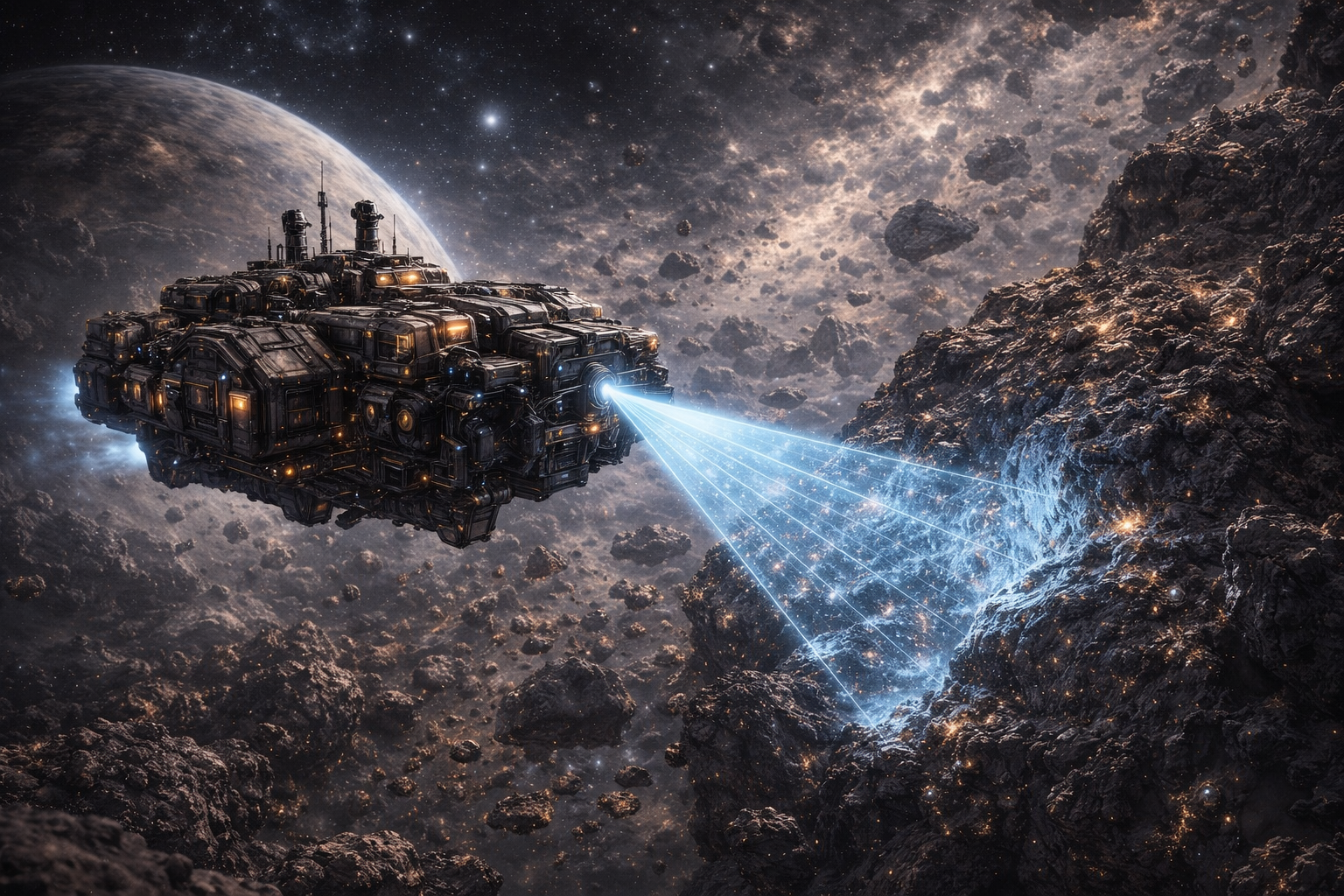
These sensors detect subtle distortions in gravitational fields caused by hidden mass.
They are particularly effective for locating large mineral concentrations within asteroid bodies.
Magnetometric Arrays
These scanners detect metallic signatures across vast distances, allowing the Cutter to identify asteroids with high concentrations of iron, nickel, and other useful alloys.
Void Echo Radar
A long-range active scanning system used to map debris clusters and detect large structural objects hidden within asteroid fields.
Mineral Spectroscopy Sensors
These sensors analyze reflected radiation to determine the chemical composition of distant bodies.
Reactor Signature Detectors
Dormant shipwrecks often retain trace isotopes from their original reactor systems.
These signatures allow Survey Cutters to locate wreckage even when it is buried within debris fields.
Together these systems allow the Cutter to build extremely detailed resource maps of the Vidar system.
Exploration Operations
When a Survey Cutter identifies a potential resource site, the crew conducts a layered evaluation process.
First, long-range sensors determine the approximate composition and mass of the target.
If the site appears promising, the vessel deploys survey drones.
These drones conduct close-range scans and gather detailed measurements.
The drones may perform:
• structural analysis of asteroids
• mineral sampling
• wreck integrity scanning
• orbital mapping of debris clusters
Once the analysis is complete, the crew calculates the expected yield of the site.
If the yield meets operational thresholds, the coordinates are transmitted to Vôrun Hold.
If the yield is insufficient, the Cutter continues its patrol.
Time spent on marginal sites is considered inefficient.
The Manifest Spine
All discoveries made by Survey Cutters are transmitted to the central data archive of Vôrun Hold.
This archive is housed within the central structural spine of the Hold’s asteroid body.
The spine functions as the core data infrastructure of the Hold.
Every discovery, survey result, and yield calculation is stored there.
The data becomes part of the Hold’s growing knowledge of the Vidar system.
Over decades and centuries, these records allow the Kin to predict where valuable resources are likely to appear.
The Survey Cutters extend the Hold’s perception outward into the system.
The Manifest Spine remembers what they find.
Crew
Each Survey Cutter operates with a crew of nine Kin, composed of both Ironkin and biological Kin.
This mixed crew structure ensures balanced operational capabilities.
Typical crew roles include:
Voidmaster
Command authority and navigation control.
Sensor Cartographer
Responsible for mapping and interpreting large-scale scan data.
Gravimetric Analyst
Specialist in mass distribution analysis and asteroid composition.
Drone Controller
Manages survey drone deployments and remote scans.
Mechanist
Maintains sensor hardware and internal systems.
Drive Technician
Maintains propulsion and maneuvering thrusters.
Systems Monitor
Oversees power distribution and data routing.
Data Archivist
Ensures collected information is correctly formatted and transmitted to the Hold.
Ironkin Logic Specialist
Provides high-speed data analysis and anomaly detection.
All Kin crew members are genetically optimized or engineered for their specific operational roles.
Competence is expected.
Prestige is irrelevant.
Endurance
Survey Cutters operate farther from Vôrun Hold than most vessels in the fleet.
Their systems are designed for extended autonomous missions.
A typical patrol may last six to nine months depending on survey route complexity.
To support this endurance, the vessels carry:
• redundant life support systems
• automated maintenance drones
• spare sensor components
• self-fabrication equipment for minor repairs
Their propulsion systems are optimized for fuel efficiency and long-duration travel rather than speed.
The Cutter moves slowly through the system, scanning constantly.
Patience is essential to discovery.
Naming the System
Survey Cutters have another responsibility beyond discovery.
They name what they find.
Asteroid clusters, wreck fields, and mineral belts discovered by survey crews are assigned designations recorded within the Hold’s data archive.
Some locations receive technical identifiers.
Others receive names tied to their discoverers or their characteristics.
Over time, these names form the cartographic language of the Vidar system.
Every Salvage Cutter captain and Industrial Hauler navigator relies on these designations.
The map of the system is written by the Survey Cutters.
The First Maps
When the Kin arrived in the Vidar system aboard Örgvayr’s Echo, the region was largely unmapped.
The first Survey Cutters deployed from the Hold spent decades mapping the asteroid belts and debris regions of the system.
Those early discoveries formed the foundation of the Hold’s industrial network.
Even today, new survey missions continue to expand that map.
The Vidar system is vast.
And the Kin believe there is always more to find.
The Beginning of Every Operation
Every Salvage Cutter deployment.
Every Industrial Hauler shipment.
Every expansion of Vôrun Hold.
All of it begins with a discovery made by a Survey Cutter.
They do not carry the ore.
They do not dismantle the wrecks.
But without them, none of those things would happen.
The Survey Cutter sees what the Hold cannot.
And because it sees, the Hold endures.