The Industrial Hauler of Vôrun Hold
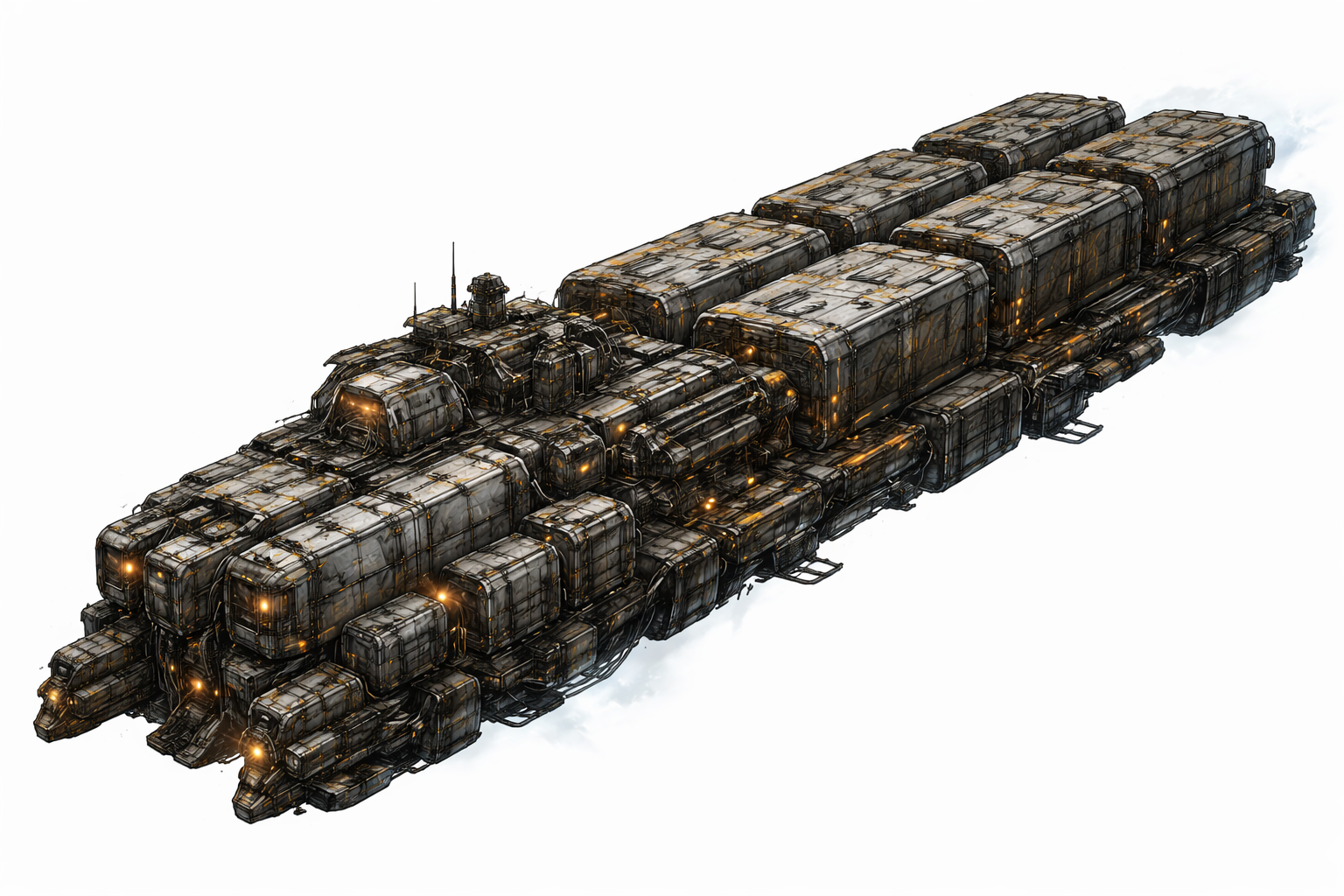
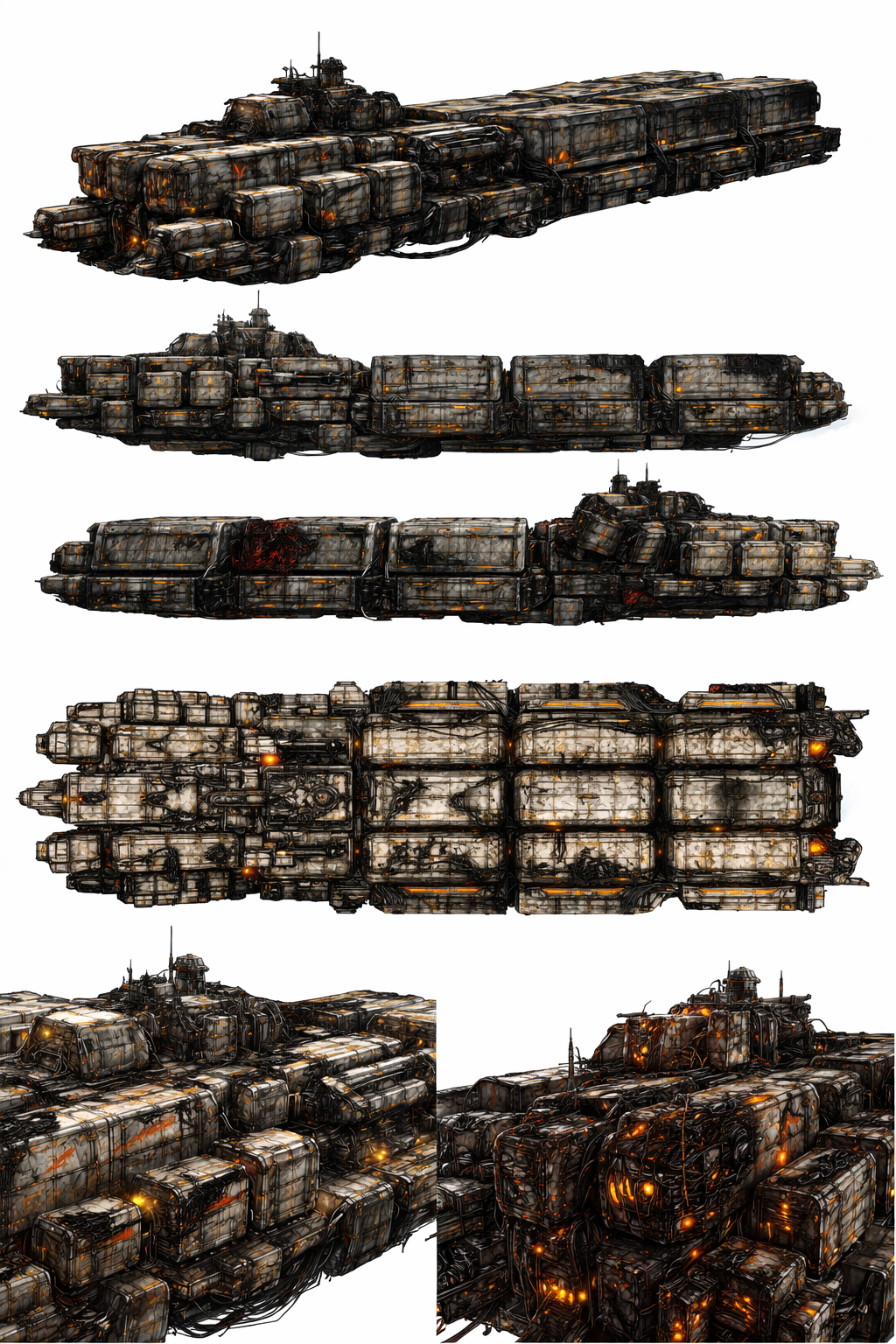
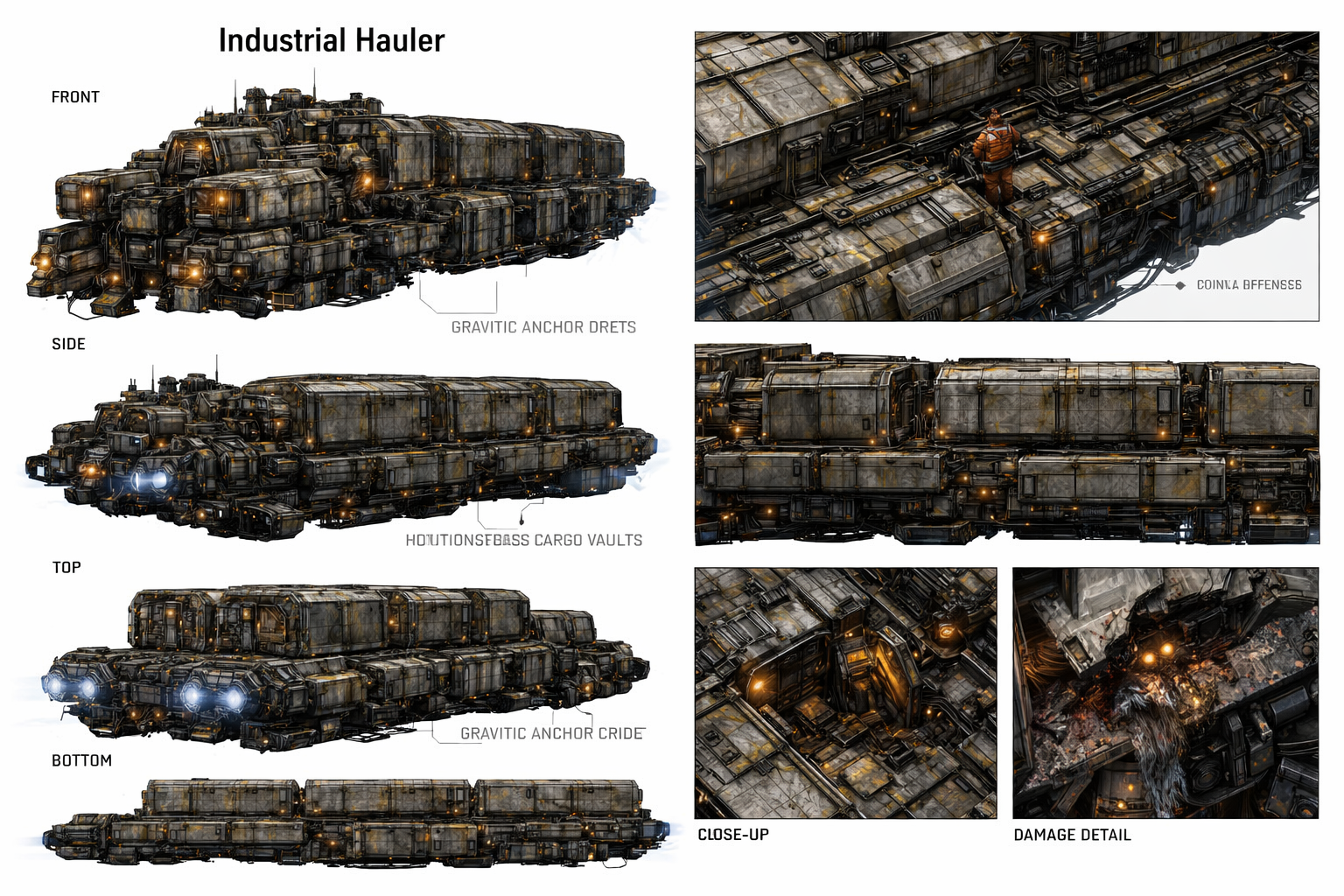
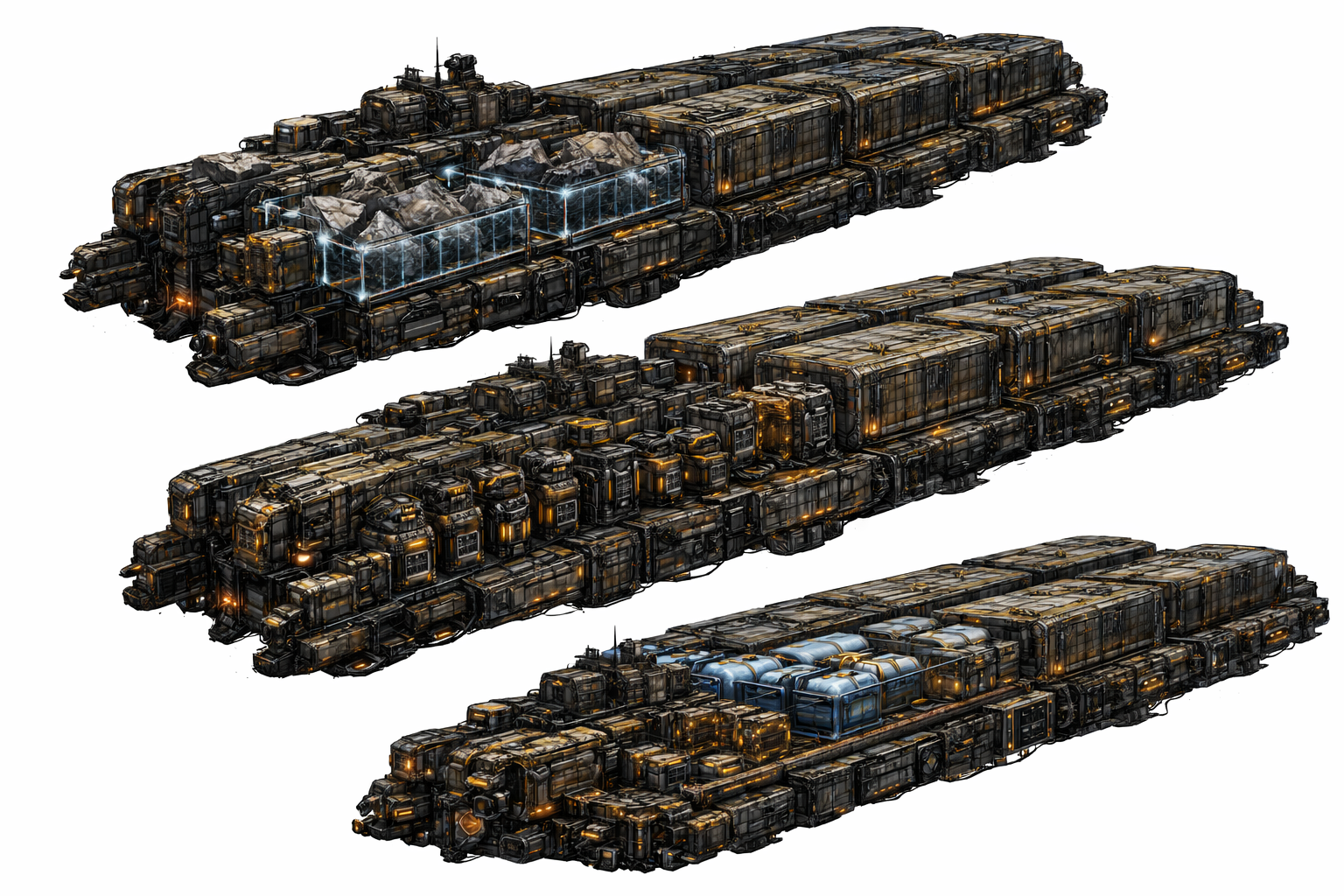

The Industrial Hauler of Vôrun Hold
The Backbone of the Hold
If the Salvage Cutter acquires resources, the Industrial Hauler moves them.
Among the voidcraft of Vôrun Hold, no vessel better represents the Hold’s philosophy of survival through industry. These ships do not explore distant sectors or pursue glory in battle.
They move mass.
Asteroid fragments. Salvaged hull plates. Industrial machines. Refinery components. Atmospheric processors. Structural alloys.
Everything required for the continued survival of Vôrun Hold passes through the cargo vaults of an Industrial Hauler.
Where other civilizations rely on fragile merchant fleets and distant trade networks, the Kin of Vôrun Hold rely on something simpler:
control of their own logistics.
Without the Industrial Hauler fleet, the Hold would not grow.
Without the Hold’s growth, the Kin would not survive.
Survival outranks triumph.
Purpose
The Industrial Hauler serves as the primary logistics vessel of Vôrun Hold’s industrial fleet.
Its function is straightforward:
Move enormous quantities of material between the Hold and the surrounding extraction zones of the Vidar sector.
Typical cargo includes:
• asteroid fragments for crushing and ore extraction
• structural alloys recovered by Salvage Cutters
• refinery components and industrial machinery
• atmospheric processors
• mining platforms
• pre-fabricated infrastructure modules
• modular cavern reinforcement frames
The Hauler does not refine or manufacture products in the traditional sense.
However, because asteroid rock forms the majority of bulk cargo, Haulers carry industrial crushing assemblies capable of breaking large stone masses into manageable ore loads during transit.
Whether crushing occurs during travel or after arrival at the Hold depends on a simple calculation:
Which option is more efficient for the Kin.
Efficiency governs all decisions.
Physical Specifications
Vessel Classification: Heavy Industrial Transport
Hold Designation: Industrial Hauler Pattern – Vôrun Iteration IV
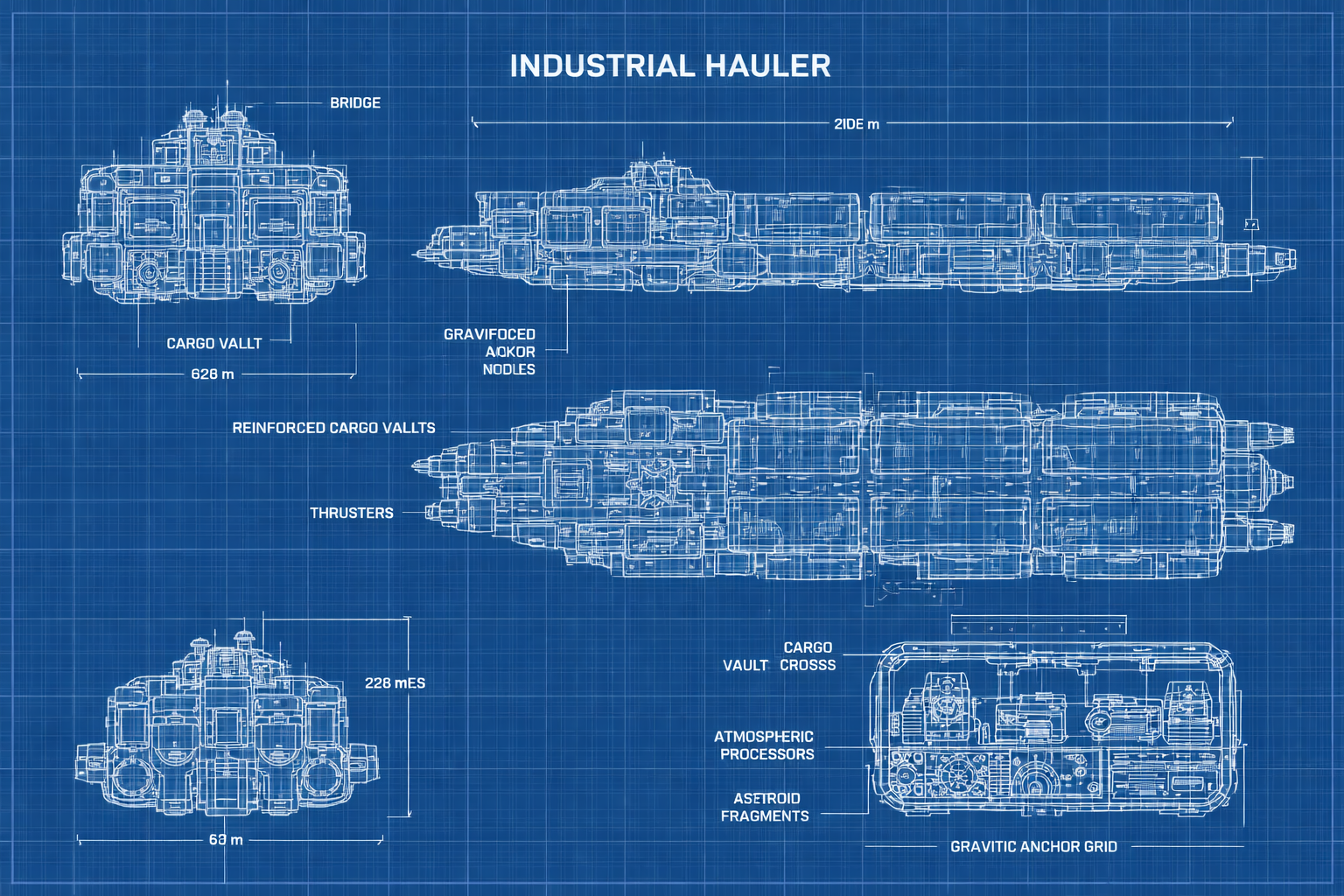
Length: 228 meters
Width: 132 meters
Height: 68 meters
Empty Mass: 120,000 tonnes
Maximum Cargo Capacity: 410,000 tonnes
Operational Mass (fully loaded): Over 500,000 tonnes
Crew: 38 Kin
Even among Kin voidcraft, the Industrial Hauler is immense.
A fully loaded Hauler maneuvering through the outer debris fields of the Hold is closer in mass to a small asteroid than to a conventional spacecraft.
Cargo Architecture
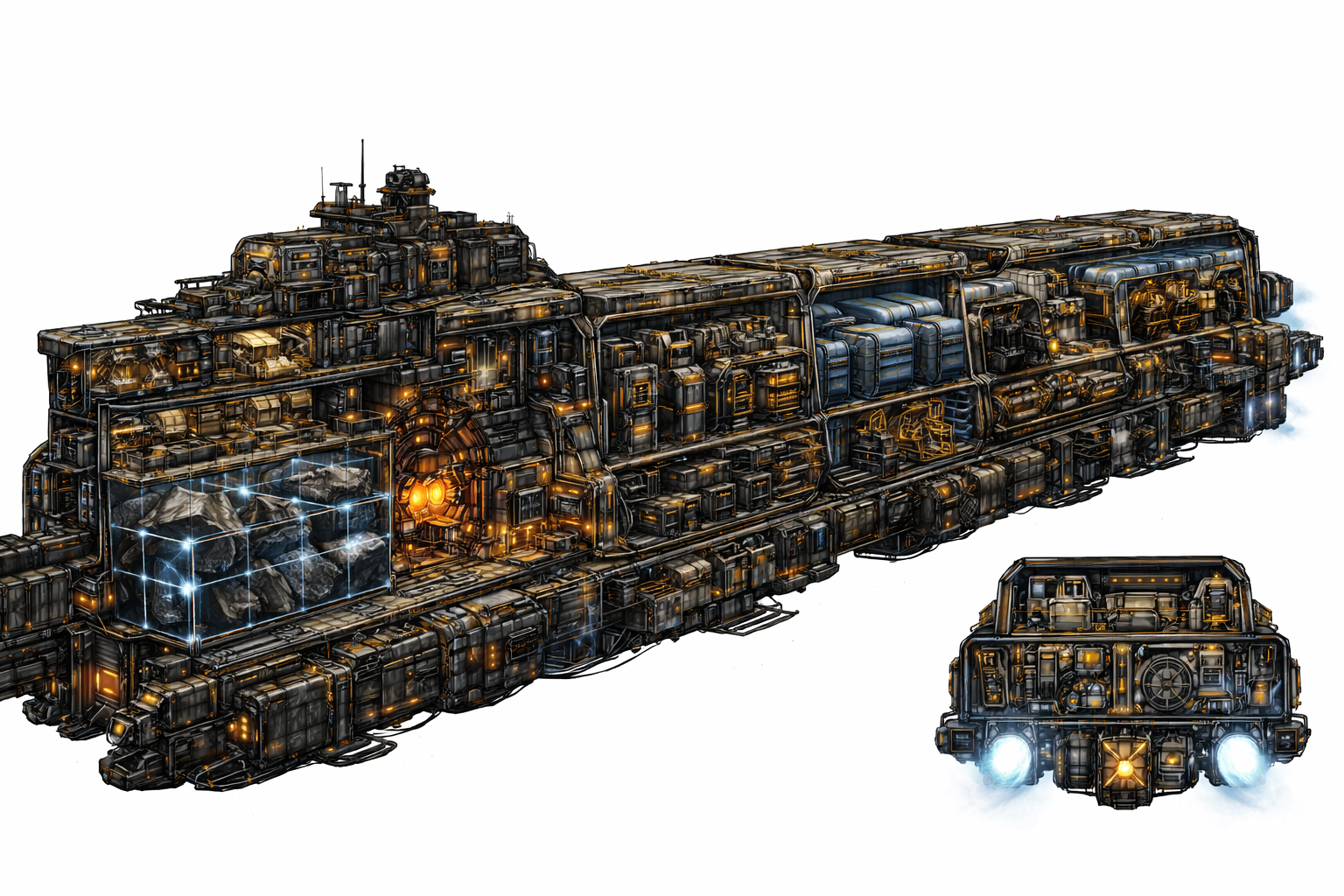
The Hauler’s internal structure is organized around three reinforced cargo vaults occupying the central mass of the ship.
These vaults are modular and interchangeable — a necessity for efficient logistics.
Each vault is designed to carry:
• asteroid fragments
• industrial machinery
• mining equipment
• atmospheric processors
• containerized infrastructure modules
Cargo is secured not with mechanical clamps but through a gravitic anchor grid projected across the vault floor.
This grid stabilizes irregular mass distributions and allows the vessel to carry objects that would otherwise destabilize a conventional cargo ship.
Because cargo modules and container frames used throughout Vôrun Hold follow standardized dimensions, Haulers can be rapidly reconfigured depending on mission requirements.
Modularity is essential.
A vessel that cannot adapt is poorly designed.
Engineering
The Industrial Hauler is built around a reinforced industrial spine running the full length of the vessel.
This structural backbone distributes the immense stresses created by transporting hundreds of thousands of tonnes of cargo.
Key engineering systems include:
Dual Industrial Reactors
Redundant reactor systems ensure continuous operation even if one system fails.
Redundancy is considered essential for ships operating far from the Hold.
Gravitic Anchor Grid
Located across all cargo vaults, this system stabilizes cargo regardless of shape or mass distribution.
It allows the Hauler to carry partially fractured asteroids without structural risk.
Structural Load Dampers
These systems absorb the stresses created when transporting uneven or shifting cargo.
Without them, the vessel’s internal frame would fracture under heavy loads.
Asteroid Field Maneuvering Thrusters
Unlike many large transports, the Hauler is optimized for navigation within dense asteroid environments.
Its thruster clusters are designed for precision maneuvering rather than high-speed travel.
The vessel is slow.
But it is extremely stable.
Operational Endurance
Industrial Haulers are designed for long deployment cycles.
A single mission may last several months depending on extraction zone distance and cargo requirements.
The vessel carries:
• extensive spare machine components
• fabrication units capable of producing replacement parts
• redundant reactor systems
• automated maintenance drones
With proper maintenance, Haulers can operate for years before requiring major refit at Vôrun Hold.
Many vessels in the fleet have served for centuries, undergoing continuous iterative upgrades.
A well-built Kin machine is never discarded.
It is improved.
Crew
Despite its size, the Industrial Hauler operates with a relatively small crew.
Crew Complement: 38 Kin
Crew organization typically includes:
Voidmaster (1)
Responsible for navigation and operational authority.
Cargo Overseers (6)
Manage cargo vault stability and logistics coordination.
Gravitic Systems Engineers (5)
Maintain anchor grid and stabilization systems.
Mechanists (8)
Maintain cargo machinery and crushing systems.
Drive Technicians (6)
Operate propulsion and maneuvering thrusters.
Logistics Officers (4)
Coordinate cargo flow with Vôrun Hold industrial command.
Drone Controllers (4)
Manage loading drones and cargo handling.
Systems Monitors and Security (4)
Monitor ship integrity and deter interference.
Kin crews are selected for their aptitude for specific tasks and are genetically engineered for those roles.
Prestige is irrelevant.
Competence is everything.
Deployment Doctrine
Industrial Haulers do not roam the galaxy.
They operate almost exclusively within the Vidar sector, maintaining the logistics network that sustains Vôrun Hold.
Only the largest Haulers occasionally leave the sector to transport particularly valuable exports produced by the Hold.
These journeys are rare.
The High Kahl Thormun has made clear that unnecessary expansion is inefficient and dangerous.
Haulers typically operate alongside:
• Survey Cutters
• Salvage Cutters
• Drone Carriers
• Vôrun Corvettes
The Hauler itself is not designed for combat.
Its protection comes from extreme armor thickness and escort vessels when necessary.
Slow it may be.
But destroying one is far from easy.
Docking Operations – Dock Ring 2
Industrial Haulers interface directly with Dock Ring 2, the heavy logistics hub of Vôrun Hold.
This docking ring was engineered specifically to process vessels of extreme mass.
Docking occurs in several stages.
Approach and Stabilization
As the Hauler approaches the Hold, Dock Ring guidance arrays synchronize with the vessel’s navigation systems.
Gravitic stabilizers gradually match the ship’s momentum with the rotating docking ring.
Once aligned, massive docking clamps engage the Hauler’s anchor nodes.
Cargo Transfer
Cargo vault access panels open directly toward the ring’s industrial loading platforms.
Cargo is removed using:
• heavy gravitic cargo loaders
• autonomous cargo drones
• modular transfer frames
Entire container modules may be removed at once.
Asteroid fragments are transferred to crushing platforms within the Hold.
Transfer Time
Because of the sheer volume of material, unloading a fully loaded Industrial Hauler can take several days of continuous operations.
Dock Ring 2 is capable of processing multiple Haulers simultaneously, ensuring that the Hold’s industrial flow never stops.
Material arrives.
Material moves inward.
The Hold expands.
Fleet Scale
Unlike Salvage Cutters, which operate in smaller numbers, Vôrun Hold maintains a full logistics fleet of Industrial Haulers.
Their constant movement between extraction zones and the Hold forms a steady industrial circulation throughout the sector.
Without this network, resource acquisition would collapse.
The Hold’s engineers consider logistics ships to be as strategically important as any warship.
Not because they are prestigious.
But because without them the Hold would fail.
Named Haulers
Each Industrial Hauler eventually receives a name.
These names often reflect the role of the vessel within the Hold’s ledger.
Examples include:
• Weight of Stone
• Burden of Iron
• Second Dividend
• Ledger of Ore
• Patient Carrier
The name marks the vessel’s contribution to the Hold.
Not its glory.
Its usefulness.
Survival Before Triumph
The Kin of Vôrun Hold do not seek conquest.
They seek endurance.
Every shipment delivered by an Industrial Hauler strengthens the Hold’s ability to survive the hostile galaxy around it.
Asteroid by asteroid.
Vault by vault.
Shipment by shipment.
The Haulers move the material.
And the Hold endures.And