The Salvage Cutter of Vôrun Hold
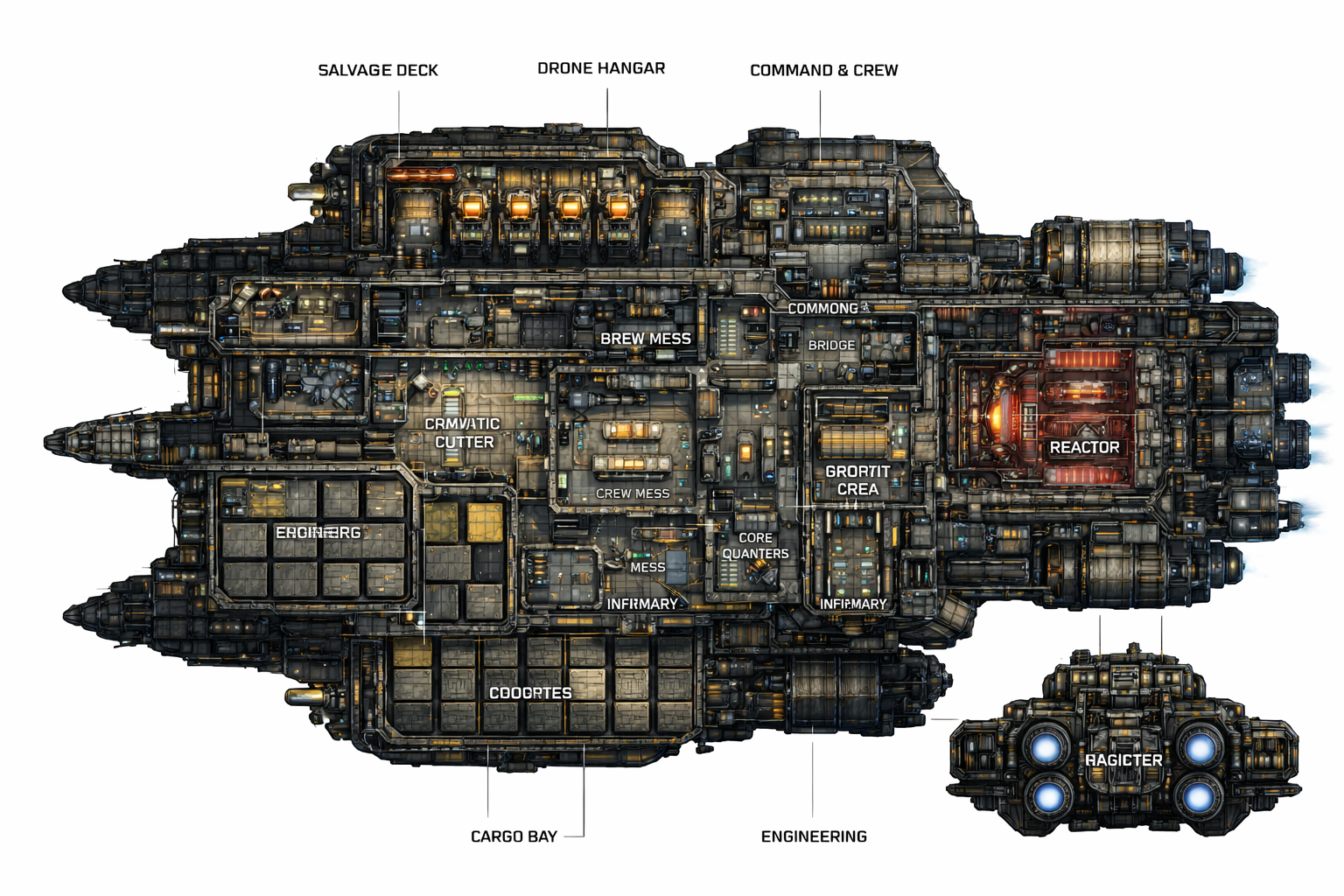
The Salvage Cutter of Vôrun Hold
Among the voidcraft of Vôrun Hold, none better represents the Kin philosophy of industry and reclamation than the Salvage Cutter.
Where other civilizations see the aftermath of conflict as ruin, the Kin see unfinished work.
A battlefield is not the end of a machine’s life — it is simply a redistribution of resources.
The Salvage Cutter exists to complete that redistribution.
Designed specifically to operate in hostile debris environments, the Cutter is neither a warship nor a transport vessel. It is a precision industrial platform built to harvest the broken remnants of void warfare and convert them into the foundations of future infrastructure.
Every beam recovered, every reactor core stripped, every fragment of armor plate reclaimed becomes part of the expanding mass of Vôrun Hold.
Nothing useful is wasted.
Technical Registry
Vessel Classification: Industrial Recovery Vessel
Hold Designation: Salvage Cutter Pattern – Vôrun Iteration VII
Primary Role: Void salvage and wreck reclamation
Physical Specifications
Length: 96 meters
Width: 54 meters
Height: 27 meters
Empty Mass: 8,600 tonnes
Operational Mass: 12,300 tonnes
Crew: 14 Kin
Operational Endurance: Indefinite with periodic reactor servicing
Role
The Salvage Cutter serves as the primary external recovery vessel of Vôrun Hold.
It operates wherever wreckage accumulates across the Vidar sector:
• battle debris fields
• abandoned mining installations
• derelict transport vessels
• collapsed orbital stations
• failed industrial platforms
The Kin do not rely solely on mining operations for raw material. Over centuries of conflict and expansion, the Vidar sector has accumulated graveyards of voidcraft and infrastructure.
Imperial patrol ships destroyed in border skirmishes.
Ork vessels shattered during raids.
Merchant convoys abandoned along long-dead trade routes.
To most civilizations, these wrecks represent loss.
To the Kin, they represent opportunity.
The Salvage Cutter converts these graveyards into supply chains.
Using articulated cutting arms and gravitic stabilization systems, the vessel dismantles wreckage piece by piece while maintaining structural control over unstable debris clusters.
Rather than towing entire hulks — a slow and inefficient process — the Cutter processes wreckage in place, reducing ships and stations into transport-ready structural segments.
These sections are transferred to Industrial Haulers or transported directly back to the Hold’s Industrial Vaults.
The doctrine is simple:
The void provides everything required — if one has the patience to reclaim it.
Crew
Despite its industrial capabilities, the Salvage Cutter operates with a relatively small crew.
Total Crew Complement: 14 Kin
Every crew member aboard the vessel is a trained specialist capable of performing multiple operational roles.
Typical crew structure includes:
Voidmaster (1)
Command authority of the vessel. Responsible for navigation, salvage authorization, and coordination with Vôrun Hold fleet command.
Gravitic Engineers (3)
Operate the articulated cutting arms, stabilization anchors, and wreck manipulation systems.
Drone Overseers (2)
Control the autonomous salvage drones used for precision dismantling and material transport.
Structural Analysts (2)
Evaluate wreck integrity and calculate dismantling patterns to prevent catastrophic collapse.
Mechanists (3)
Maintain plasma cutters, drone racks, industrial processing systems, and power routing.
Drive Technicians (2)
Maintain propulsion systems and maneuvering thrusters during delicate salvage operations.
Quartermaster / Systems Monitor (1)
Maintains the salvage ledger, catalogues recovered material, and coordinates logistics with the Hold.
Kin crews operate with quiet efficiency. Communication aboard the Cutter is precise and minimal.
Each action contributes directly to the Hold’s ledger of recovered resources.
Deployment Doctrine
Salvage Cutters rarely operate independently.
Instead they function as part of a coordinated industrial task group within the Vôrun Hold fleet.
Operations typically begin with a Survey Cutter, which maps potential salvage zones.
Sensor arrays identify:
• intact reactor systems
• recoverable hull structures
• dormant machine logic fragments
• unstable wreck zones
Once the site is assessed, Salvage Cutters are dispatched.
Upon arrival the Cutter deploys void-stabilization anchors, securing its position relative to large debris structures.
This creates a stable work zone where dismantling operations can begin.
From this position the Cutter deploys:
• salvage drones
• gravitic clamps
• plasma cutting arrays
Large wrecks are dismantled methodically. Smaller fragments are processed directly into structural sections.
Operations may last hours in small debris clusters or weeks in the aftermath of large fleet engagements.
The Kin measure success not in time spent, but in tonnage reclaimed.
Minimal Armament
The Salvage Cutter is not designed for combat.
However salvage zones often attract opportunists — pirates, scavengers, and raiders seeking to claim wreckage fields.
To discourage interference, the Cutter carries limited defensive systems:
• point-defense turrets
• light rail cannons
• electronic countermeasure emitters
These systems exist purely for deterrence.
Their purpose is simple:
to convince opportunists that interfering with Kin salvage operations is a poor decision.
In high-risk zones, Vôrun Corvettes provide escort.
Structural Layout
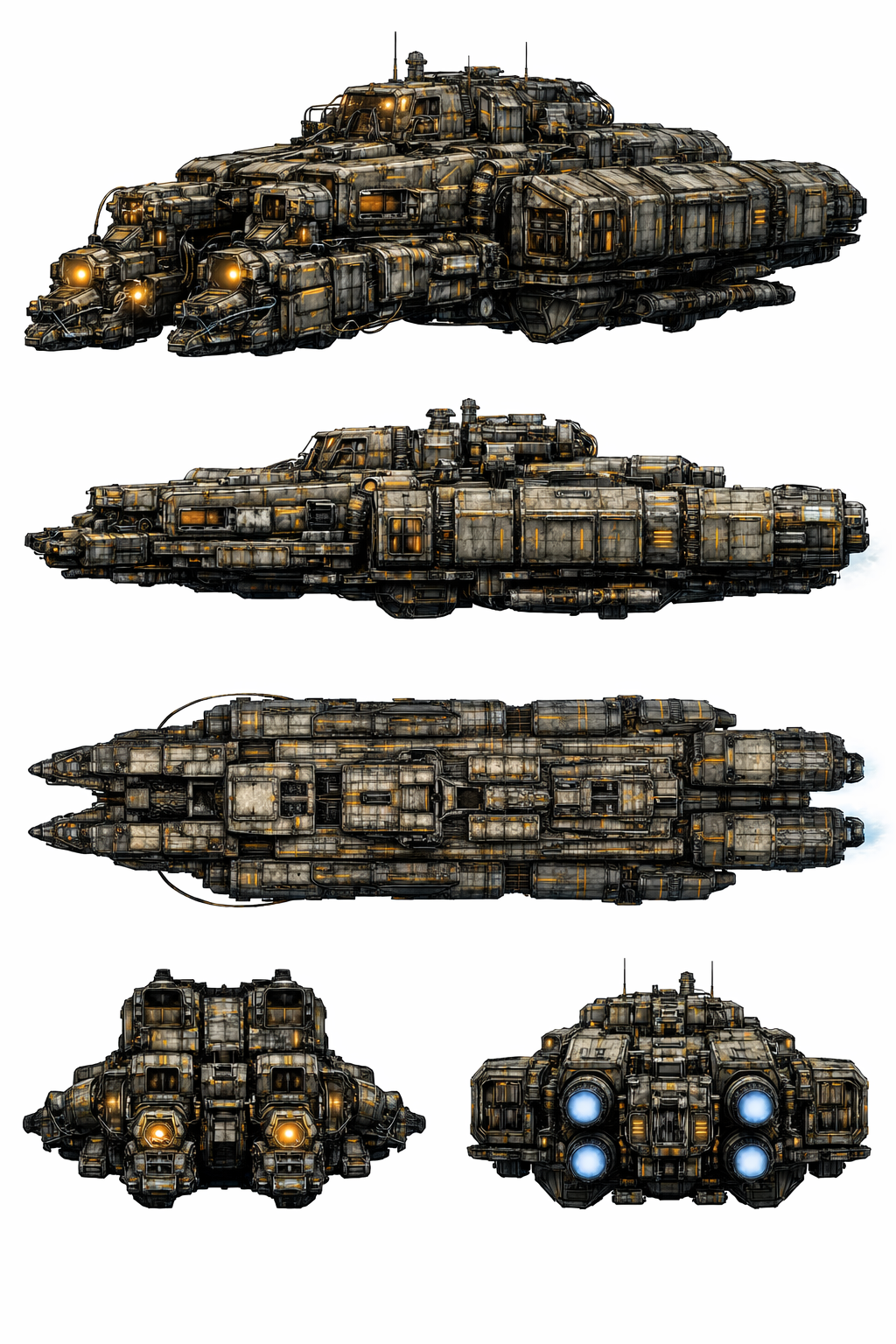
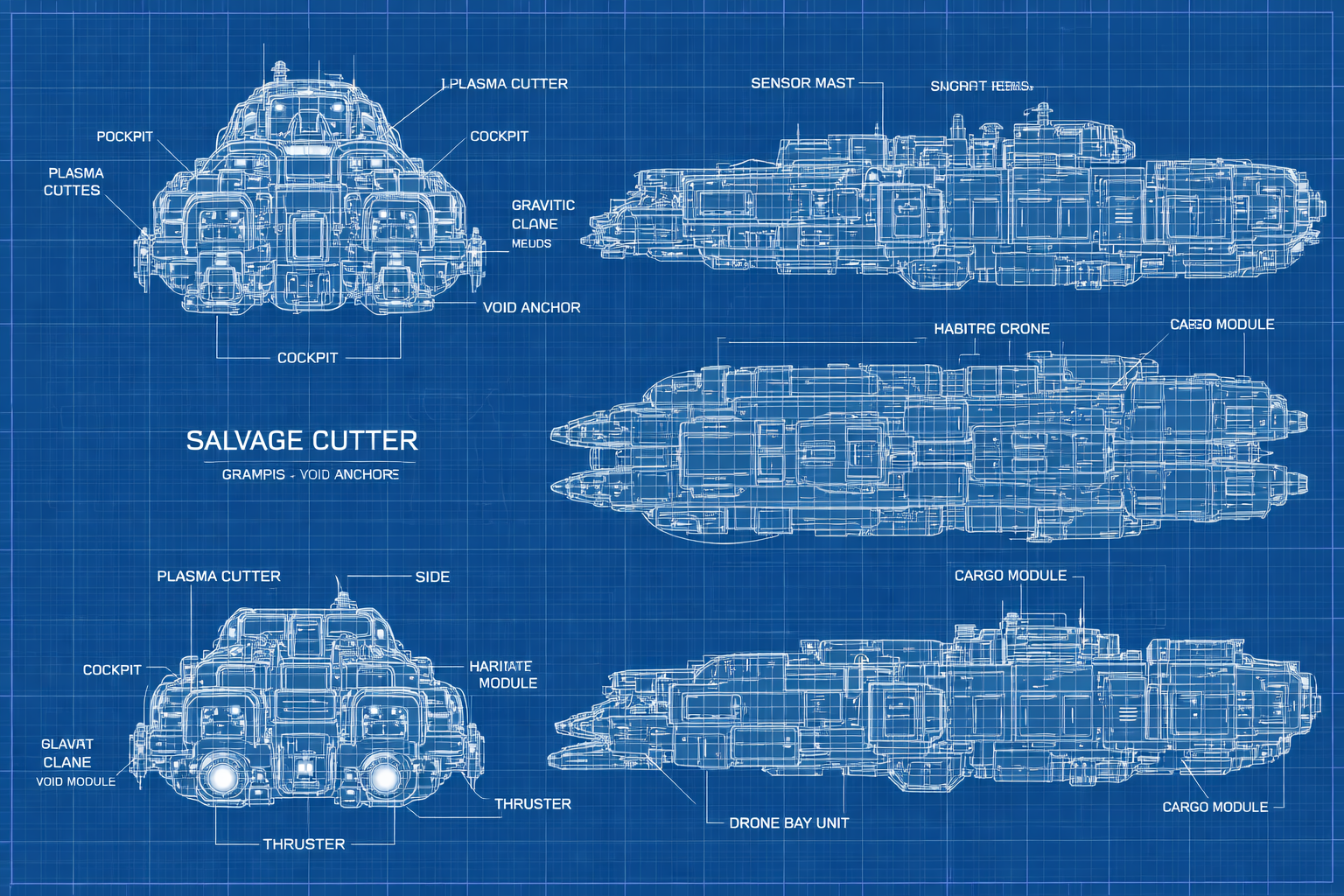
The Salvage Cutter’s frame is built around a reinforced industrial spine designed to distribute structural loads during heavy dismantling operations.
The vessel’s broad beam provides stability while operating within dense debris clusters.
Internally the vessel is divided into three primary decks.
Upper Deck — Command and Salvage Control
This deck houses:
• the bridge and command station
• gravitic cutting arm control systems
• drone operations consoles
• navigation and sensor arrays
From here the Voidmaster directs dismantling operations.
Mid Deck — Crew and Industrial Systems
The central deck contains the operational core of the vessel:
• drone hangar
• salvage processing bays
• crew quarters
• mess and infirmary
• structural analysis stations
Recovered material is stabilized and catalogued here before transport.
Lower Deck — Engineering and Cargo Processing
The lower deck houses:
• the primary reactor core
• propulsion systems
• cargo processing chambers
• structural storage bays
This deck also contains the void anchor deployment systems used to secure the Cutter during salvage work.
Forward Salvage Assembly
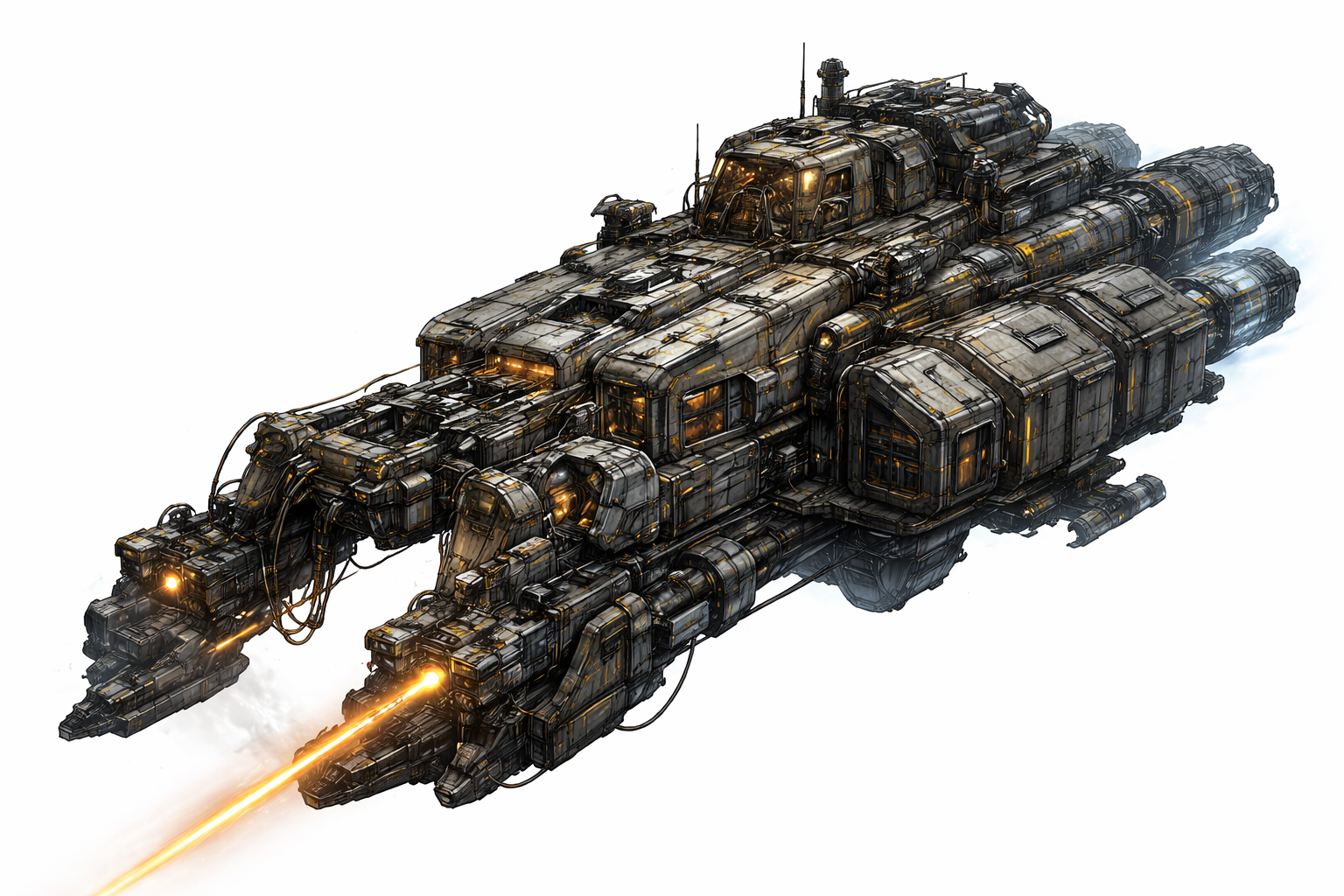
The Cutter’s most distinctive feature is its twin articulated gravitic cutting arms mounted along the forward hull.
Each arm integrates multiple industrial systems:
• plasma cutting arrays
• gravitic manipulation emitters
• heavy stabilization clamps
• structural stress sensors
Together they allow the vessel to dismantle massive wreck structures while preventing uncontrolled collapse.
This precision is essential when operating within unstable debris fields.
Design Lineage
The Salvage Cutter design is unique to Vôrun Hold.
Unlike many Kin vessels shared across Leagues, this design has evolved through iterative engineering within the Hold’s industrial guilds.
Every generation of Cutter incorporates improvements learned from previous salvage operations.
Better stabilization systems.
More efficient cutting arrays.
Improved drone integration.
Some of the oldest Salvage Cutters currently in service arrived aboard Örgvayr’s Echo during the early Diaspora migration from the Galactic Core to the Vidar sector.
These ancient ships have been rebuilt and refitted many times over the centuries.
Their hulls bear the marks of countless operations.
Yet they remain in service — proof of the Kin belief that a well-built machine should never be discarded.
Salvaging the Unknown
The Kin of Vôrun Hold are pragmatic.
If recovered technology improves industrial efficiency, it may be studied and repurposed.
This includes xenos technology recovered within the Hold’s operational zones.
However strict security protocols govern such recovery.
Recovered components must pass through Hold security analysis before integration into industrial systems.
Unstable or corrupt technology is destroyed.
Useful machine logic may be adapted.
Efficiency always outweighs ideology.
Fleet Integration
Salvage Cutters form one part of the Hold’s wider industrial fleet.
They commonly operate alongside:
Survey Cutters
Mapping salvage zones and identifying recoverable wreckage.
Industrial Haulers
Transporting processed materials back to Vôrun Hold.
Drone Carriers
Providing additional autonomous cutting and mining units for large-scale salvage operations.
Vôrun Corvettes
Maintaining defensive perimeters around active salvage sites.
Together these vessels form the backbone of the Hold’s resource recovery infrastructure.
Named Vessels
Each Salvage Cutter eventually earns a name.
Some are named after legendary salvage operations. Others after the Voidmasters who commanded them.
A Cutter’s name becomes part of the Hold’s ledger.
It marks not only the vessel itself — but the value it has returned to the Kin.
A Machine of Continuity
Across centuries of operation, Salvage Cutters have quietly reshaped the structure of Vôrun Hold.
Fragments of ancient warships now reinforce the Hold’s outer bastions.
Armor recovered from forgotten battles forms the skeleton of mining platforms.
Entire sections of derelict stations have been rebuilt into new industrial vaults.
The Kin do not discard the past.
They rebuild it.
Every wreck harvested by a Salvage Cutter becomes another entry in the Hold’s ledger.
And every entry strengthens the future.