Vôrun’s Return
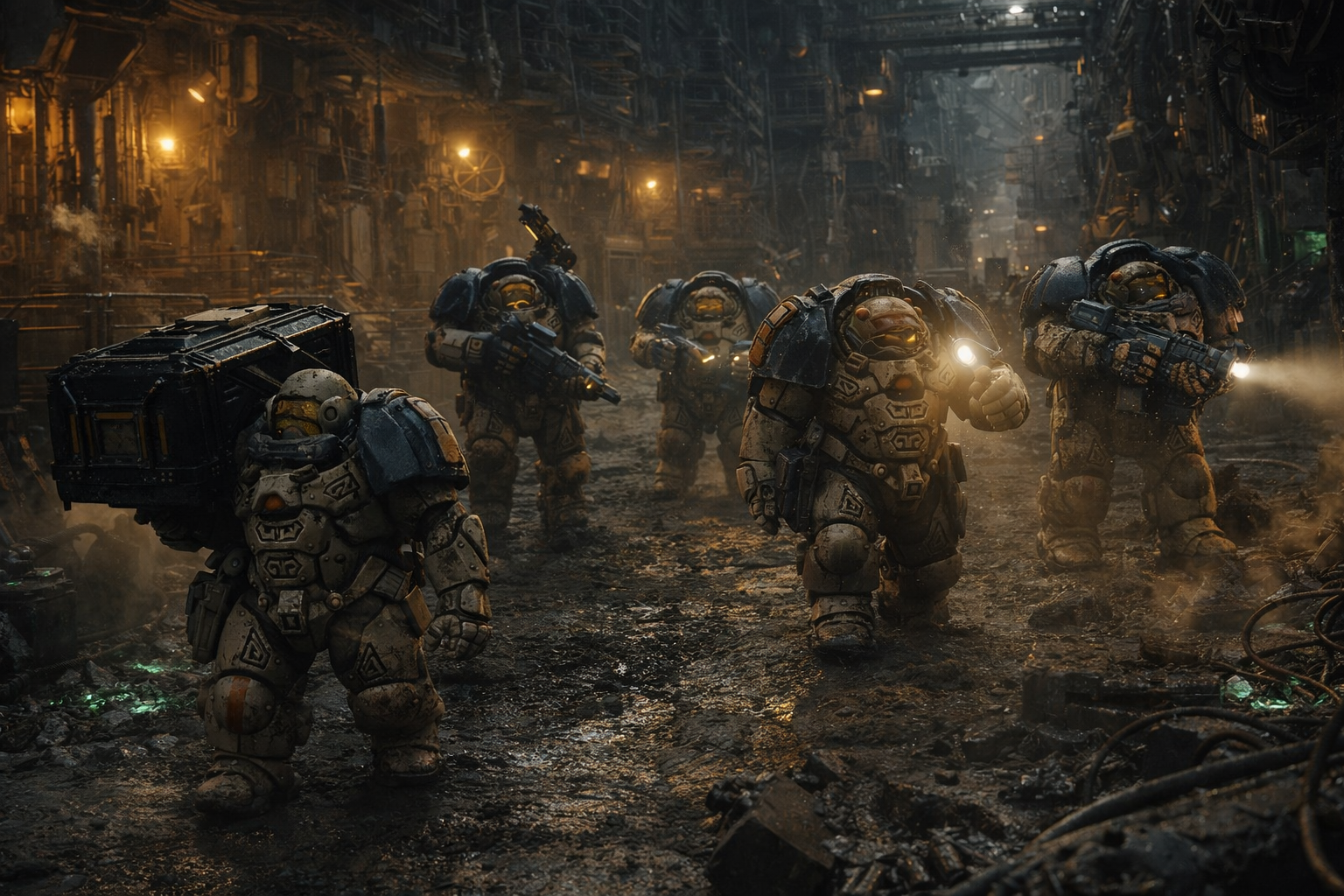
Vôrun’s Return
The Sealed Hands of Vôrun Hold
There are losses that can be priced.
There are losses that can be endured.
And there are losses that, if left buried, broken, or taken, do not remain losses for long. They become distortion. They enter the route. They enter the ledger. They enter the future as error.
That is when Vôrun’s Return is sanctioned.
Proceed under seal. Return if warranted.
Vôrun’s Return is a Hold-born Einhyr formation raised not for glory, procession, or line-breaking display, but for the hardest recoveries the Hold can still justify. They are deployed when proof, memory, route-truth, or a continuity-bearing asset is at risk of becoming unrecoverable; when ordinary salvage crews cannot be trusted with the burden of what must be found; when an extraction must come back intact under all circumstances; or when the site itself is already under threat from forces too dangerous, too disciplined, or too interested to ignore. In such moments, the problem has already crossed threshold. It is no longer salvage. It is continuity under pressure.
Their ground is the kind of ground Hypnoth keeps for itself: buried levels under collapsed forge-shells, sealed vaults whose locks still answer dead systems, dead stations drifting with intact archive ribs, hull breaches gone black and cold, route-black sites where readings lie cleaner than stone, vitrified belts where heat killed everything but not its value, and red-band salvage zones where usefulness and danger have already become the same entry written in different ink. Hypnoth is rich in this kind of work. That is one reason Vôrun’s Return exists at all.
They are not copies of Môktar Vôrunsdóttir.
They know that plainly.
Môktar was the first Hold-born Einhyr proof that the Deep Hearth could bring such a pattern to viability under Vôrun conditions. Her existence made later outputs thinkable, but Vôrun’s Return was not raised to make more hammers. It was raised because one hammer was not enough. The Hold learned that not every existential threat arrives at the bastion wall. Some vanish downward. Some disappear into sealed decks, broken records, damaged route-logic, entrusted burdens, and assets whose absence would deform future decisions long before anyone called it defeat. Vôrun’s Return is the answer the Hold built for that lesson.
Their ethic is simple:
Favor the long term.
They do not chase trophies. They do not optimize for immediate yield. They do not measure success in bodies dropped or tonnage stripped. They recover what the Hold cannot afford to let become absence. Their hierarchy of return is known within the sealed record and understood by those few who are allowed to sanction them: proof first, memory second, continuity-bearers third, bounded-danger assets fourth, structural salvage only after the rest is secured. They are not sent because something is expensive. They are sent because losing it would make Vôrun wrong later. That distinction is the whole unit.
When their work begins, the handover is formal and final:
This is no longer salvage. Seal the return.
Once deployed, Vôrun’s Return operates as the Hold’s highest authority for critical retrieval in the field. Their missions are sanctioned upward by leadership, but on site their judgment is not second-guessed by dock overseers, salvage guilds, or line commanders who arrived too late to understand what the site has already become. They answer to Thôrmun Vôrrek and Eidram Vôr-Index, and their sealed logs are restricted accordingly, with Kâl-Vôrun retaining record authority over what is entered, what is held, and what remains deferred. Wherever possible, Uthar’s Margin is kept outside their affairs. Some returns are Vôrun-specific inventory in the deepest sense of the term. Thôrmun prefers them weighed within the Hold before they are made legible to power beyond it.
That discretion has given them a practical reputation.
Not glorious. Not feared in the monumental way of Vôrun’s Wall. Not watched with the unease that follows Uthar’s Margin through corridors and gantries. Practical.
They are known in the Hold as Kin who can still be spoken to. They are seen without armor. They are more likely than the other Einhyr formations to be found at a dock canteen, in a survey alcove, or walking a lift-rib with dust still in the seams of their gloves. They are less polished, more field-shaped, more willing to improvise, and less symbolically burdened than the Wall. They speak in forge, dock, and route-house register, not in carved oaths. They do not sound elite unless the work demands it. Among themselves, their phrases are plain, useful, and already half-worn by repetition: Bad history. Sound return. Not clean. Still ours. If it holds, carry it. Wrong place. Right load. Logged. Lifted. Gone. We take back the missing. Return before ruin settles. Hold the route. Lift the proof.
Elsewhere in the Hold, they are called by two names.
The public one is the Sealed Hands.
The common one is simpler.
The Returners.
Both fit.
They work closely with Keln Veyd and the Yaegirs of Vôrun’s Reach, because a sealed recovery begins long before the exo-armour locks. Keln’s work is in route honesty, pressure signs, fall-back geometry, peripheral truth, and the disciplined reading of danger before it has to be named. His Yaegirs find sites, test approaches, confirm false readings, and carry the sort of intelligence that tells Vôrun’s Return whether a place is merely buried or already becoming a trap. The relationship is unusually easy by Vôrun standards. Keln understands the difference between a target and a burden. They understand the value of a route that stays honest long enough to get home.
Their relationship with Durn Khel is less easy.
Necessary, but strained.
Of the Hold’s Einhyr formations, Vôrun’s Return breaks the most, interrupts the most, and arrives least in step with forge planning. They bring back objects that do not belong on schedules. They return sealed burdens that force layered isolation, emergency recalibration, altered shift patterns, and long arguments over whether a thing is useful, merely dangerous, or both in a ratio no one wants to log aloud. Durn does not despise them. That would be too simple. He resents their timing, distrusts their prizes, and rarely receives the benefit of their work in any clean or routine way. But he knows the Hold needs them, which is the harder burden.
Not every sealed return is a good one.
Vôrun’s Return knows this better than most. There are burdens recovered intact that still enter the Hold wrongly; proof that arrives too late to prevent correction; survivors whose usefulness returns with them, but so does a harder thing—grief sharpened into appetite, vengeance given room to circulate, memory that does not steady the ledger but unsettles it. In such cases, the Return has done its work correctly and still doubts the wisdom of where that work was brought.
This is one reason some within the formation speak quietly of the difference between a sound return and a clean one. A thing may be recovered under seal, entered properly, and still carry forward the wrong kind of fire. Vôrun’s Return does not confuse extraction with success. It favors the long term, even when the long term only becomes visible after the burden is already home.
They operate most often in small retrieval cells: three operators and one rotating lead selected by mission fit rather than fixed title. Vôrun does not waste hierarchy where pattern and competence can do better work. On deeper or broader sites, multiple cells scale into layered entry and return patterns. Only in rarest escalation do they deploy beside both Vôrun’s Wall and Uthar’s Margin, and when that happens the distinction between defense, correction, and recovery collapses into one temporary continuity formation. Such convergences are remembered. They mean the Hold has judged the matter too consequential for separation.
Their most terrible successful return remains unspoken in ordinary conversation but impossible to forget among those who know the sealed record. They brought back a phase reactor whose geometry suggested shorter total warp transit at the cost of exponentially greater exposure with every use: a device too strategically useful to discard, too unstable to celebrate, and too foreign in consequence to ever be considered ordinary salvage. It did not make them famous. It made them necessary. That is a better Vôrun measure.
When Vôrun’s Return fails, the loss is rarely simple. It is not just Kin. It is proof that cannot be reconstructed. It is route-truth that cannot be checked twice. It is agricultural or systems knowledge whose absence enters future shortages. It is components that would take the Hold centuries to make again. It is entrusted burdens whose disappearance forces escalation the moment the ledger is opened. Their failures do not merely reduce stock. They distort decision. That is why they are sanctioned so narrowly, and why they are trusted so far once they go.
Vôrun’s Wall stands until the ledger closes.
Uthar’s Margin ensures that drift does not pass for judgment.
Vôrun’s Return goes where the Hold has already begun to disappear from itself and brings back the part that still counts.
Not everything.
Never everything.
Only what the future cannot be allowed to lose.
Proceed under seal. Return if warranted.